
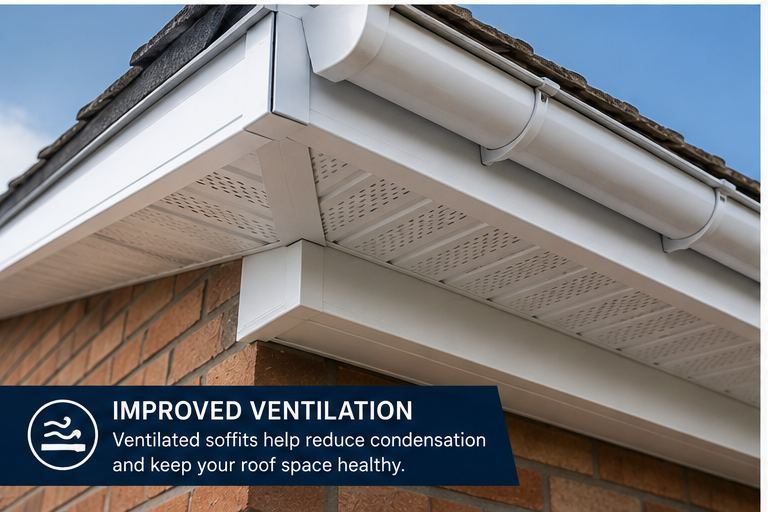
Vents in the soffit let air pass through the roof space and carry damp away. Here is why that matters on Nailsea houses and bungalows, and how we fit vented boards when we replace the eaves.
A roof space with no airflow slowly turns into a damp box. Moist air from the house rises and settles on cold timber and felt, and without a way out it stays. A vented soffit is how we give it an exit, and it is a small detail that protects the whole roof over time.
How the air moves
Fresh air comes in at the eaves, rises along the underside of the roof and leaves at the ridge or through other openings. This gentle flow carries off moisture before it can collect. The vents do not make the loft cold or draughty; they keep a small, steady exchange of air so rafters, felt and insulation stay dry.
In a bungalow or a low-pitched estate roof, the air path is short and any block at the eaves has more effect, which is why we keep insulation back from the gap. A roof space that is kept moving in this way also lasts better, because nothing sits damp for long enough to rot, rust or grow mould.
Why modern living adds to the problem
Houses built after the war were designed with less insulation and more natural leakage. Since then, windows have been sealed, lofts insulated, and bathrooms and kitchens added or extended. More moisture goes up and less escapes, so older eaves that once coped can now struggle. Nailsea's many extended and updated estate homes are good examples.
- Loft insulation pushed tight into the eaves
- Extractor fans venting into the roof space
- Bathrooms and kitchens added during extensions
- Old vents painted over or blocked up
Signs of a roof that cannot breathe
Typical signs are condensation on the underside of the felt, a musty smell in the loft, black spotting on timber, rusty fixings and damp insulation. Because the effects look like a leak, they are often misread. We check the eaves and airflow as part of a roof inspection, because a leak and a ventilation fault need very different cures.
Mould on rafters, damp patches on the ceiling away from the leak line and a roof space that smells stale after rain are all clues we note on a visit to Nailsea homes. Together these tell us whether the airflow is the problem, and whether improving it will be enough or the roof covering needs attention as well.
What goes in with new boards
When fascias and soffits are replaced, we fit vented soffit boards or discreet vent strips along the run, keeping openings protected from insects and weather. We check rafter ends and the eaves first, keep insulation clear of the gap and set vents evenly. On older homes we check what existing soffit boards are made of before disturbing them.
Exposure and the finished eaves
Nailsea's westerly weather means eaves face wind and rain, so fixings, joints and gutter brackets matter as much as the vents. We refit or replace the gutters at the same time, in a white, darker or wood-effect finish to suit the house. The eaves end up square, tidy and breathing, with a surface that only needs a wipe.
Frequently Asked Questions
Do bungalows need soffit vents too?
Yes, in most cases. Bungalow roof spaces are often broad and shallow, and moisture can build up easily. We check the roof space and fit vents that suit the layout and insulation. The fix depends on the roof layout.
Can too many vents make the loft cold?
Vents do not cool the rooms below if insulation is laid properly. They ventilate the roof space, not the living space, and we keep the insulation in place while leaving a clear gap for air at the eaves. Both jobs happen together.
Can vents be added without replacing the boards?
Sometimes, by fitting vent strips or cutting in vents to sound boards. If the boards are rotten or the rafter ends need attention, replacement is better, and we explain which suits your eaves.
Talk to our team about UPVC fascias and soffits in Nailsea
Every roof is different — the fastest way to get an accurate answer is a quick chat with our team.