
A garage roof replacement follows a set order: survey, strip, repair the deck, lay the new covering and finish the edges. Here is how it goes for Ridgeway garages.
Garages alongside Ridgeway's inter-war and post-war houses often have flat roofs that have outlived their covering. Replacing one is a short, tidy job when it is well planned. This guide takes the stages in order, so you can tell what is happening on site and ask the right questions.
Surveying before we begin
We look at the roof, the walls it sits on and the way water leaves. We check inside for staining on ceilings or beams, and note the gutter, the edges and any junction with a house wall. This lets us describe the work in writing and flag anything that may change once the old roof is off.
Garages built with the house can share a wall, a gutter or a rainwater pipe with the main roof, and those links need care. We check how water from the house roof reaches the garage roof, and whether it lands on it, so that the new covering is not asked to cope with more water than it should.
Taking off the old covering
The old layers come off and we clear them as we go. Garage roofs often carry several layers from past repairs. Stripping to the deck lets us see boards and joists plainly, check for rot and decide what to repair. We protect the inside of the garage while the roof is open.
- Old layers removed down to the deck
- Debris cleared and the site kept tidy as we work
- Boards checked for rot, damp and movement
- Contents protected from dust and weather
Deck, falls and insulation
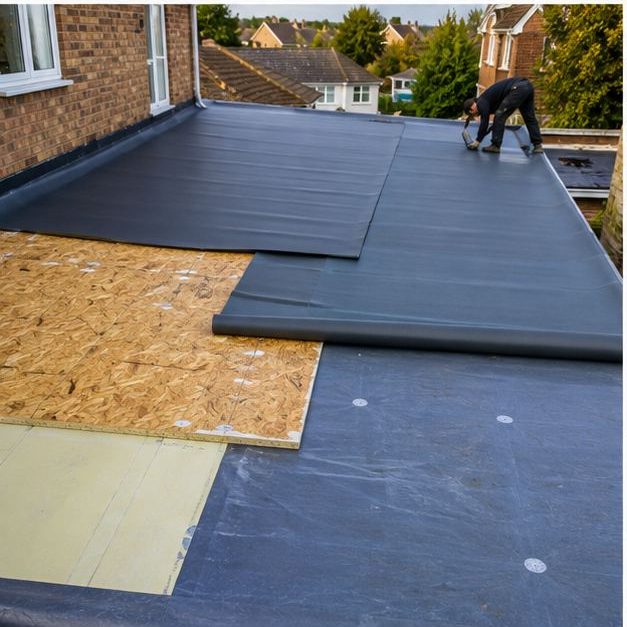
Soft boards are replaced, joists are checked and falls are corrected so water runs to the outlet. If the garage is used for more than parking, insulation can be added. The deck is made flat, dry and sound before the covering is laid on it, as the covering is only as good as its base.
Where the deck is rotten in several places, we explain whether replacing a few boards is enough or whether the whole deck should be renewed. Fitting new boards in patches over old joists is fine if they are sound. If they are not, it is better to find out now than after the covering is down.
The new covering and edges
Depending on the roof, we may use single-ply rubber, fibreglass or a felt system. Edges, upstands, corners and outlets are formed with care because those are where flat roofs usually fail. The roof is finished with edge trims and a gutter check, so rain leaves cleanly. If the garage roof joins the house wall, the junction is flashed or sealed properly, so water cannot track behind it.
Questions worth asking
Ask for a written description of the work, what happens if rot is found, how the open roof is kept dry and how the site is left. Ask which covering is proposed and why. It may need planning or Building Regulations checks — we advise before work starts.
Frequently Asked Questions
Do I need to empty the garage?
You do not need to empty it, but moving valuables, bikes and anything that dislikes dust away from the walls and ceiling helps. We tell you what to move and protect what remains.
Can the garage roof be insulated?
Often yes. It makes the most sense if the garage is a workshop, gym or hobby room. We discuss what suits the use and the roof build, and how insulation affects the edges and falls of the roof.
Will the new roof look different from the old?
Slightly, perhaps. Single-ply and fibreglass roofs have a clean, smooth finish with neat trims, while felt is more textured. We explain how each will look at the edges, so the finished roof holds no surprises.
Talk to our team about flat roofing in Ridgeway
Every roof is different — the fastest way to get an accurate answer is a quick chat with our team.