
Vented soffits let air move through a roof space so moisture does not build up. Here is why it matters on hipped Ridgeway houses and their extensions.
Nobody sees the airflow in a roof, but you notice when it is missing: damp insulation, mould on rafters, a musty loft. Vents in the soffit are the simplest way to bring fresh air in. On Ridgeway's hipped roofs, the eaves run right round the house, so there is plenty of room for it.
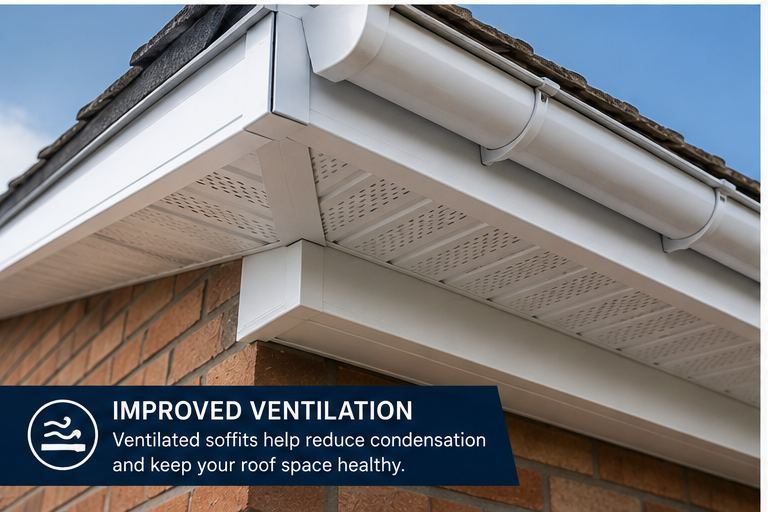
Moisture has to go somewhere
Everyday life puts water into the air: cooking, washing, showers, drying clothes. Warm air rises and carries that moisture into the loft. If it cannot escape, it meets cold timber and felt and turns to water. A steady flow of air from the eaves carries it away.
Modern boilers, tumble dryers and sealed windows have made houses tighter than the ones these roofs were built to serve. That puts more moisture into the air than the original builders expected, so ventilation at the roof edge does more work now than it did when the house was new.
Eaves all round on a hipped roof
A hipped roof has eaves on every side, which gives you a long, even line for air to enter. That is a good thing, as the air can sweep across the whole roof space. It only works if the soffit is vented, and the vents are not blocked by insulation or old paint.
- Vented soffit boards that let air in along the eaves
- Vent strips fitted behind the fascia board
- A clear gap kept above insulation at the eaves
- Ridge or tile vents to let moist air leave
Extensions and converted lofts
An extension roof or a loft room often has its own small roof space, sometimes with no ventilation at all. Moisture there is trapped, which causes damp in a smaller area. We look at how air could be brought in, and whether the extension roof and main roof are connected properly.
Signs of poor ventilation
Water droplets on the underside of the roof covering, black spots on timber, damp or compressed insulation and a smell of damp in the top floor all point towards poor airflow. Windows that mist in bedrooms are sometimes a clue as well, since the house itself is carrying too much moisture.
Not every mark is condensation. A stain with a clear tide line, or one that appears only after heavy rain, may be a leak. We look at both possibilities and tell you which it is, because ventilation will not stop a leaking tile and a new tile will not cure a damp, unvented loft.
What changes when we replace soffits
When we take off old boards and gutters, we check the rafter ends and eaves, and on an older house we also check what existing soffit boards are made of before disturbing them. New vented soffits or strips go in with the fascia, and we leave a clear air path above the insulation.
Frequently Asked Questions
Can vents be added to existing plain soffits?
Often yes. Round vents can be fitted into existing boards, or the boards can be replaced with vented ones. Whether that is enough depends on the size of the roof space and the other ventilation.
Do vented soffits make the house colder?
No. The vents let air into the roof space, which is outside the insulated part of the house. Properly fitted, insulation keeps the heat in the rooms below while the roof space stays dry.
Is a vented soffit only for new fascias?
No. It can be added when old boards are replaced or even separately where the fascia is sound. Replacing both at once tends to be tidiest, because the same scaffold and labour are used.
Talk to our team about UPVC fascias and soffits in Ridgeway
Every roof is different — the fastest way to get an accurate answer is a quick chat with our team.