
Rubber, fibreglass and felt each suit a different kind of flat roof. We explain how to match the covering to the extension.
Extensions across Hengrove often go onto the back or side of an inter-war or post-war semi, a short terrace home or a bungalow, and most use a flat roof. There is no universal best covering, only the right fit for the shape, use and deck. This guide runs through the main options and the questions that decide.
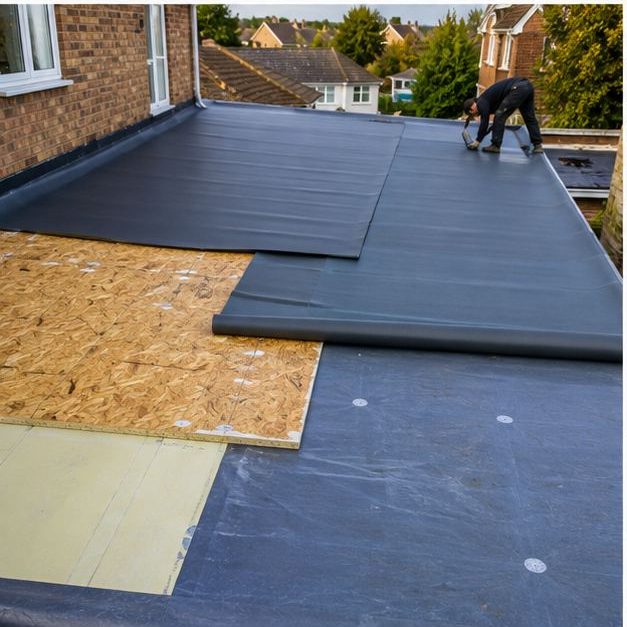
A rubber membrane (EPDM)
Single-ply rubber comes in large sheets, so a plain rectangular extension can be covered with few joints. It tolerates some structural movement and goes on neatly when the roof outline is simple. On roofs with many corners or pipes, the extra detailing takes more care and more skill.
A rubber sheet also suits a garage roof that is plain and rectangular, which describes many in the area. Once the deck is dry, sound and correctly sloped, the membrane can go down quickly, with careful finishing left for the edges and the wall junctions.
Fibreglass (GRP)
Fibreglass is laid in place and forms a continuous hard shell with no laps. It suits roofs with lots of upstands, odd shapes or a need for neat edge trims, and it takes foot traffic well. It does need a firm, dry deck, because a moving surface can crack a rigid finish.
- Complicated outlines with many upstands
- Roofs that are walked on regularly
- Decks that are firm and well fixed
Felt systems
Layered felt is widely used on garages, porches and small extensions. It can be bonded or torched in place, and repairs are straightforward. The quality of work at the laps, edges and upturns decides how it performs, so ask how those will be formed and who will carry out the work.
Felt is sometimes dismissed as old-fashioned, but modern felt systems are a different thing from the felt of the past. A well-finished roof of this kind is a sensible choice for a garage or small extension, and repairs later are usually easy to make.
The parts that matter as much as the top layer
Falls, insulation and ventilation matter as much as the covering. A flat roof that holds water wears faster whatever it is made of. An extension roof also needs a deck fit for purpose and a build-up that meets the insulation needs of the room beneath it.
If a bungalow extension joins the main roof, the abutment where flat meets pitched needs special care. That junction takes runoff from the higher slope, so it is a frequent source of leaks and needs a proper flashing detail, not just sealant.
- Falls that carry water to an outlet
- Insulation layer that suits the room
- Neat edge trims and gutter arrangements
- Sound deck beneath the covering
Questions to put to a roofer
Ask for the make-up of the roof in layers from the deck up, how the edges and wall junctions will be dealt with, and what will happen if the deck proves rotten. An extension roof may need planning or Building Regulations checks — we advise before work starts.
Frequently Asked Questions
Which material suits a small porch or bay top?
Small awkward areas often suit fibreglass or a careful felt detail, because of the many edges and corners. The decision depends on the shape and how the roof meets walls, and we assess it on site. Small porch tops and bay roofs often favour a different approach.
Does the material affect the warmth of the room?
The insulation layer matters more than the top covering. A roof built with proper insulation and ventilation keeps the room more comfortable, whatever the covering. We choose by the shape of the roof and how it is used.
Can I choose a colour?
Some systems offer limited colour choices, and trims can be selected to suit the house. Practical performance should lead the decision, though, and we talk through what is available for your roof. We talk through the choices on site.
Talk to our team about flat roofing in Hengrove
Every roof is different — the fastest way to get an accurate answer is a quick chat with our team.