
Before agreeing to a dry verge, there are a handful of things worth checking on your own roof. Here is the list we work through.
A dry verge is a good solution for many gable edges, but it only works when the pieces suit the roof beneath them. Hengrove's mix of inter-war and post-war semis, short terraces and modern infill means tile types vary from house to house. Checking the details before you commit saves disappointment afterwards.
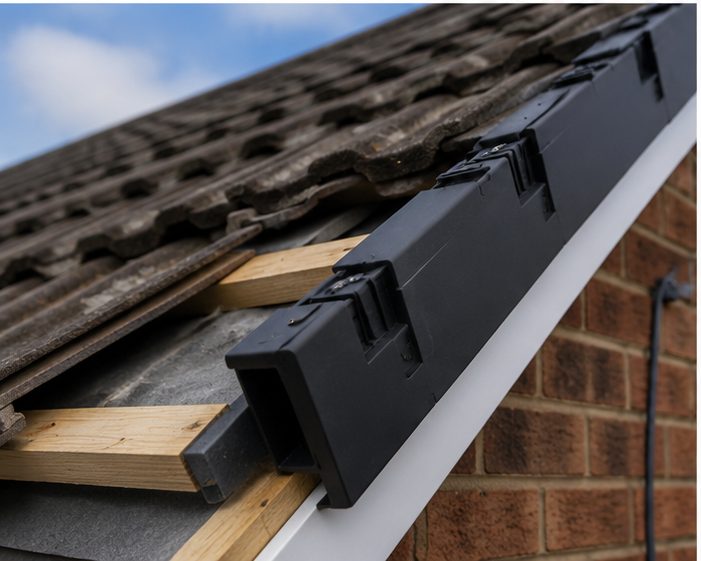
Look at the problem first
Falling mortar on paths and drives, gaps at the gable edge and cracked end tiles are the usual signs. Take photographs from the ground and note whether the problem is at one gable or several. Do not go near the edge yourself. What you see from below is enough for us to start from.
Tile profile and compatibility
Verge units fit specific tile shapes. Compatibility depends on the tile profile, which we check on site, because photographs rarely show enough. If the tiles are an older or unusual type, there may be no matching unit, and then a different edge finish may be the better answer.
- Tile shape and size at the gable
- Whether a matching unit exists
- Colour match to the existing roof
The state of the roof behind the edge
The units fix into the roof structure, so the battens and edge timbers need to be sound. If they are rotten, they must be repaired first. A dry verge is not a cure for a roof failing elsewhere, and finishing the edge on a worn-out slope only hides the real fault.
How it will be fixed
Ask how the units will be secured and whether the maker's fixing guidance will be followed. The answer should be mechanical fixings into the structure, with no reliance on mortar. Ask also how the ridge end and the lower edge will be finished, since those are the awkward spots.
A roofer who can explain these points calmly and without hurrying is a good sign. If the answers are vague, or the quotation only says dry verge with no detail, ask for it to be spelled out before you agree to anything. Ask for anything unclear to be written down.
- Fixings into the roof structure
- Treatment of the ridge end
- Neat finish at the eaves end
- Written description of materials used
Practical questions
Ask how access will be arranged, what happens to debris, and how the work will be left. Where a roof edge is altered, it may need planning or Building Regulations checks — we advise before work starts. We would sooner explain and agree these points before starting than discover them part way through.
Take your time over the decision. Falling mortar is a nuisance, but it is rarely an emergency, and it is better to choose the right system calmly than to rush into the wrong one. We are happy to go through your options without any pressure at all.
Frequently Asked Questions
Can I check the tile type myself?
You can note the shape and colour from the ground and send photographs. Matching units depend on the exact profile, so we confirm it on site before ordering anything. Always ask for the description in writing.
What if my gable edges are all different?
That is common on terraces and semis that have been altered over the years. Each gable is judged on its own, and we do not assume one solution will suit every edge. Gables vary from house to house.
Will a dry verge stop birds getting in?
The closed edge pieces leave far less gap than old mortar does, which makes it much harder for birds and insects to get into the roof space. Correct fitting is what achieves it. We confirm it before ordering.
Talk to our team about dry verge systems in Hengrove
Every roof is different — the fastest way to get an accurate answer is a quick chat with our team.