
The middle of a flat roof is rarely where it leaks. Edges, trims and wall upstands take the strain, and this is how they fail.
Garages and extensions are common across Hengrove's inter-war and post-war estates, and many carry flat roofs. When one of these leaks, the cause is more often at an edge or where the roof meets a wall than across the open surface. Those details move, weather and open up, and they need looking at closely.
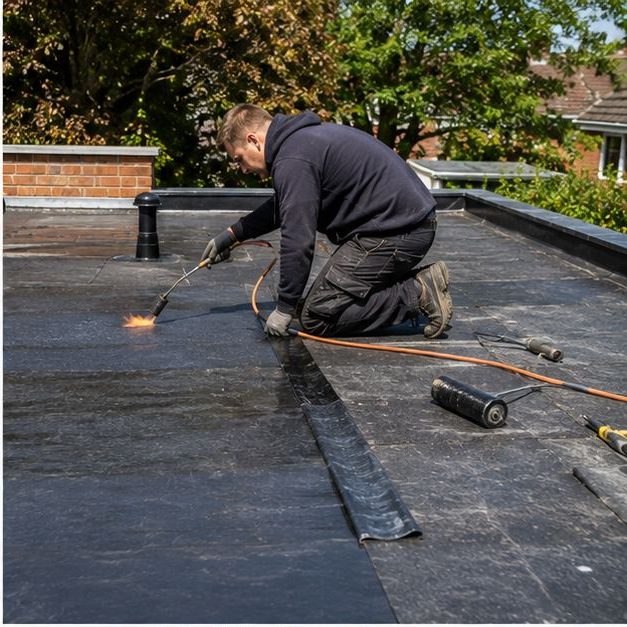
What an upstand is
An upstand is where the covering turns up a wall, such as where a garage roof meets the house or a boundary wall. The turned-up edge has to be fixed, sealed and covered at the top with flashing. If any part of that fails, water runs behind it and into the structure.
Edges and trims
At the roof's outer edge, a metal or plastic trim guides the covering over the edge and into the gutter. Trims can loosen, split or be installed with gaps. Wind then lifts the covering and rain gets under it. Drips onto the wall below, or stains under the eaves, often point here.
- Trims loose, bent or open at the joins
- Covering lifting at the outer edge
- Staining or algae on the wall below
Why abutments open up
Buildings move slightly, and a roof stuck to one wall can be pulled away by that movement. Sealant dries and cracks, mortar joints behind lead or flashing crumble, and covering that was only lightly stuck lets go. Sunlight and cold cycles work on the same joints year after year.
Garages built against the side of a semi are especially exposed to this, because the roof is pinned to a wall that has its own movement and weather to cope with. Over the seasons the joint between the two is asked to do a great deal.
What we check and what we do
We examine edges, upstands, joints and corners for splits, lifting and gaps, then check the deck for damp where water has been getting in. Repair can mean re-sealing, renewing a trim, or fitting new flashing. If water has spread under the covering, a larger section needs stripping and relaying.
Where the whole roof is tired, replacement is a better use of effort than patching every edge. New covering can then be taken properly up the wall and over the trim in one go, with the layers arranged so that water always sheds away from the joint.
- Corners and wall junctions checked closely
- Condition of trims and fixings
- Soft decking near the leak
- Outlets and gutters at the low edge
What to ask a roofer
Ask how the junction at the wall will be finished, how the edge trim will be fixed, and whether the deck underneath will be checked. A good answer describes the layers in order. We explain what we find and show you photographs so you can see the cause.
Photographs of stains inside the garage or extension help us decide where to start looking, as does a note of when the drips happen. Wind-driven rain and long wet spells point to different weak points, and that history saves us time on site.
Frequently Asked Questions
Why does my garage roof leak only at the wall?
The junction between roof and wall is a weak point, as the covering, flashing and sealant must all stay joined while the building moves. A failure there lets water behind the upstand. The cause is usually found without lifting much.
Can sealant alone fix an upstand leak?
Sometimes as a short-term measure, but sealant ages and cracks. If the underlying flashing or covering has failed, a proper repair or renewal gives better results, and we advise on which applies. We explain which it is.
Should I worry about water at the roof edge?
Yes, it is worth checking. Water at the edge can soak the deck and fascia, and may be a sign the trim has failed. A quick look from the ground can tell you a lot. A quick ground-level look can tell us a lot.
Talk to our team about flat roofing in Hengrove
Every roof is different — the fastest way to get an accurate answer is a quick chat with our team.