
A fascia is only a board, but it protects the ends of the rafters and carries the gutter. Once it fails, damage tends to travel up into the roof.
Many Hengrove homes are inter-war and post-war semis and bungalows with deep hipped roofs, where the eaves run all the way round the house. That is a lot of fascia, soffit and gutter, and any weak point lets water into the roof edge. So yes, a damaged fascia can lead to wider roof problems, and sooner than people expect.
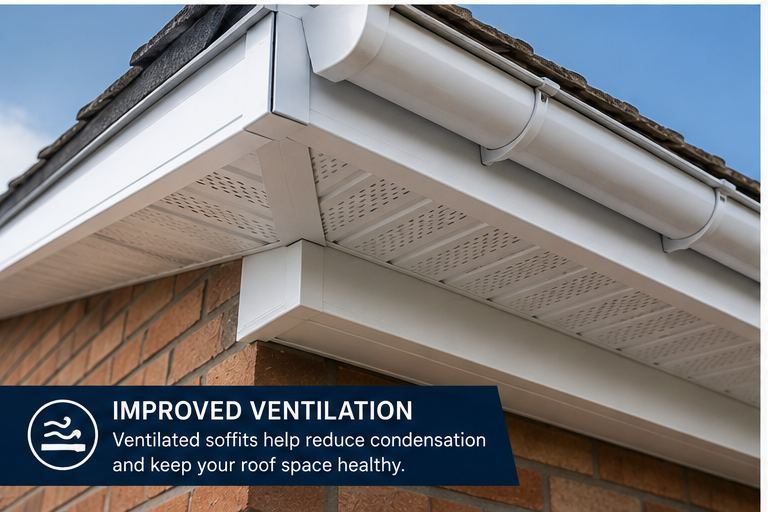
What sits behind the board
The fascia is fixed to the ends of the rafters, with the soffit beneath closing the underside of the eaves. Behind them lie the rafter feet, the roof felt and the wall plate. All of these are timber and all need to stay dry. A failing fascia removes the protection from that whole edge.
How the damage spreads
Rain gets behind a split or rotten board and soaks the rafter ends. Gutters lose their support and sag, so water spills down the wall instead of reaching the downpipe. Damp moves into the roof felt and timbers, and gaps in the eaves let in birds, wasps and insects. Each step makes the next repair larger.
- Sagging gutters and overflow marks on walls
- Timber at the rafter ends turning soft or dark
- Pests using gaps at the eaves
- Ceiling stains along the outer edge of rooms
Hipped roofs and bungalows
On a hipped roof, the fascia turns corners and runs on every side, so there are more joints where water can enter. Bungalows have a lower eaves line, which means gutters sit close to the wall and any overflow quickly marks the brickwork. Garages with their own boards share the same problems on a smaller scale.
What we look at
From the ground we note sagging, peeling, open joints and gutters dripping behind. Once access is arranged we check the rafter ends behind the boards, the felt dressing into the gutter and the ventilation at the soffit. Where older soffit boards are in place, we check what they are made of before disturbing them.
- Rafter feet and wall plate condition
- Felt lap into the gutter
- Soffit ventilation to the roof space
- Gutter brackets and the line of the run
Dealing with it early
Replacing failing boards before the rafter ends go is usually the tidier job. New boards, vented soffits or vent strips and refitted gutters let the roof space breathe and keep the edge dry. UPVC is cleaned, not painted, and very low maintenance. Call us if you notice sagging gutters or flaking boards from the ground.
Gutters should be checked at the same time, since a sagging run puts extra strain on the new boards. New boards also give the new gutters a firm, level base to hang from, which helps them clear water properly in heavy rain and keeps the wall below dry.
Frequently Asked Questions
Can a bad fascia cause damp in the loft?
Yes, it can. Water entering at the rafter ends can follow the timbers and felt into the roof space. Poor eaves ventilation can also add condensation, so we check both when we look at the boards. We trace it properly.
How do I know if the rafter ends are affected?
Often only a close look behind the boards will show it, which is why we check them when the old fascia is removed. Signs from outside include soft board edges and staining on the soffit.
Is it worth doing only the worst side?
Sometimes, if the other sides are sound and the gutter run can be split sensibly. Where boards on several sides are failing, doing the whole house at once usually makes better sense for access. We advise either way.
Talk to our team about UPVC fascias and soffits in Hengrove
Every roof is different — the fastest way to get an accurate answer is a quick chat with our team.