
The middle of a flat roof is rarely where it leaks. The edges and the places where it meets a wall take the movement and the weather, and that is where we look first.
A flat roof is only as good as its joints. The surface in the middle is often in good order while a water leak is working its way in at the edge trim, at the wall junction or around a rooflight. On extensions and garages in Emersons Green, these details are the usual culprits.
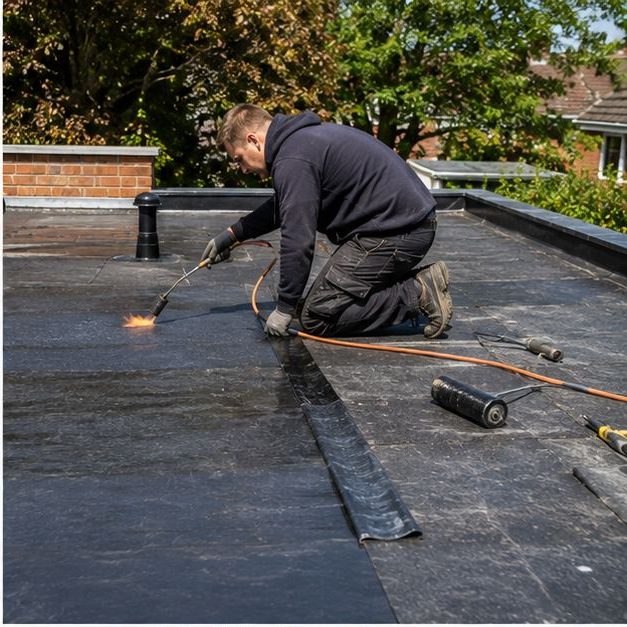
What an upstand is and why it matters
An upstand is where the roof covering turns up a wall, a parapet or a kerb, so water cannot run behind it. The covering is tucked into or lapped over the wall and then protected by a flashing or capping. If any link in that chain lets go, water finds its way behind the covering and into the deck.
Why upstands fail
Walls and roofs move at different rates, and the junction between them takes the strain. Over time the covering can pull away, the sealed top edge can open up, and the flashing or mortar joint above can crack. A short upstand leaves little margin when water pools against it, so any build-up of leaves or debris makes the problem worse. Leaves, moss and silt gather in the same corners, hold moisture against the join and make a small gap into a steady leak.
Why edges leak
The edge of the roof, where the covering finishes over a trim and drips into the gutter, is exposed to wind and sits close to running water. A trim that has lifted, a covering that has curled back, or a gutter set too high or too low can send water back under the edge instead of away from it.
- Edge trim that has lifted or come loose
- Covering curled or split at the drip edge
- Gutter position sending water back under the roof
- Open joints where the trim sections meet
How we trace the problem
We start from inside, noting where damp shows on ceilings and walls, then work back along the deck and joints. On the roof we check the covering around the edges, the upstand height and condition, the flashing above it and the outlets. Water usually leaves a clue at the point where the surface has moved or opened. We also look inside the building, because ceiling stains near an outside wall tell us a good deal about which edge is letting water in.
The repair itself
Where the covering is otherwise sound we cut back the failed section and re-form the upstand or edge with new material, properly lapped and secured. Flashings and trims are renewed where they have failed. If the deck beneath has been wet for a while, we expose it and replace damaged boards before closing it up again.
Frequently Asked Questions
Is sealant enough to fix a leaking upstand?
Sealant can hold for a short time, but it is not a proper repair for a junction that is moving. A lasting fix means renewing the failed covering or flashing so that it is secured mechanically and shed water by its shape.
Why does my extension ceiling stain after wind and rain?
Wind-driven rain pushes water into any open joint at the edge or wall junction. When the weather is calm it stays dry. A stain that comes and goes with the weather often points to an edge or upstand defect.
Can blocked outlets cause edge leaks?
Yes. If water cannot drain away it backs up and sits against upstands and edges that were never meant to hold standing water. Keeping outlets clear and having them checked is a simple way to reduce the risk. Please call us for a proper look rather than climbing up.
Talk to our team about flat roofing in Emersons Green
Every roof is different — the fastest way to get an accurate answer is a quick chat with our team.