
Sometimes a fascia can be put right in place; sometimes the honest answer is new boards. Here is how we decide, and what the decision depends on.
A fascia that looks tired does not always need ripping off. Equally, a quick fix on a board that is failing behind the surface only delays the bill. Homes in Emersons Green are mostly fairly modern, so many fascias are sound but dirty or loose. Here is how we work out which route fits your house.
When a repair is enough
If the boards are straight, firm and securely fixed, a repair is often all that is needed. Loose sections can be refixed, a cracked corner replaced, gaps in the joints dealt with and gutters realigned. Dirty or stained UPVC is very low maintenance and is cleaned, not painted, so discolouration alone is not a reason to replace. If we think it will fail again soon, we say so.
Signs the boards should come off
Soft or rotten timber, bowed or split boards, and sections that no longer stay in line suggest the board has given up. Repeated gutter leaks soaking the same area tell us the board behind may be damaged. If the fault is widespread along the roof edge, piecemeal repairs tend to leave a patchwork of old and new that fails again soon. If the fault is only at one corner or one length, a localised repair is perfectly reasonable and we will say so.
- Boards that bow, split or twist away from the rafters
- Soft or crumbling timber behind the surface
- Gaps at joints that keep opening after repair
- Damp or stained soffit boards beneath the fascia
What we find behind the board
The board is only part of the picture. Once a section is lifted we can see the rafter ends, the soffit and the state of the eaves. If the rafter ends are damp or marked, the cause has to be dealt with, otherwise a new board would be fixed to a problem. This is why we look before we agree a scope. Often that conversation is the point where a repair turns into replacement.
What replacement involves
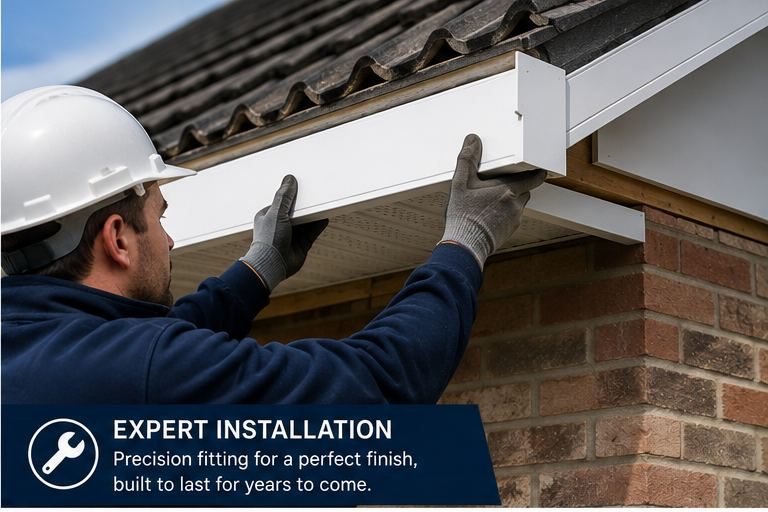
Replacement means removing the old boards and gutters, checking the rafter ends and eaves, fitting new fascias and vented soffits or vent strips, and refitting or renewing the gutters. Scaffold or other safe access is needed. Finishes include white and darker or wood-effect options, so you can match or change the look of the house. Gutters are checked for slope and brackets before they go back up, and replaced where they have become brittle or misshapen.
Deciding on the day
We will show you what we find, say what we would do and explain why. Some work can wait; some should not. Where we are in doubt we say so. On older properties we check what existing soffit boards are made of before we disturb them, so the work is done the safe way. A clear, written description of the work should be given before anything starts.
Frequently Asked Questions
Can I paint over faded UPVC fascias?
Painting is not usually recommended. UPVC is cleaned rather than painted, and a good clean often restores the finish. If the surface is damaged or discoloured beyond cleaning, replacement boards in white or a darker finish are the better route.
Do I need to replace the gutters with the fascias?
Usually the gutters have to come off to take the boards away, and they are often refitted if sound. If they are cracked, sagging or badly jointed, it makes sense to renew them while access is in place.
Will new fascias help with damp in the loft?
They can, if the soffit also gets proper ventilation. Vented soffits or vent strips let air move through the roof space, which cuts condensation. If the damp comes from a leak elsewhere, we will point that out.
Talk to our team about UPVC fascias and soffits in Emersons Green
Every roof is different — the fastest way to get an accurate answer is a quick chat with our team.