
Ridges and flashings sit at the joints of a roof, where water is most likely to get in. Here is what the repair work actually involves on newer homes in Emersons Green.
The ridge runs along the top of the roof and the flashings seal the places where the roof meets something else, such as a chimney, a wall or a porch. Both take the brunt of wind and rain. On the planned estates of Emersons Green, with their concrete tiles and dry-fixed fittings, the repair is usually tidy and contained if it is caught early.
What the ridge does and how it fails
Ridge tiles close the gap where two roof slopes meet and keep rain and wind out of the roof space. On many older roofs they are bedded in mortar that cracks and drops out. On modern dry-fixed roofs the pieces are held by clips, screws or ridge fittings, and these can loosen, rust or be lifted in a gale.
Checking a ridge before any work
We look from the ground first, then closely at the roof itself. We are looking for tiles that have shifted, gaps at the ends, loose fixings and mortar or filler that has failed. In the loft we check for daylight along the ridge line and for damp on the timbers beneath it.
Nothing is repaired until we know whether the fault is the ridge itself or something else underneath it. Nothing is repaired until we know whether the fault is the ridge itself or something underneath it, because a new ridge on a failing roof only hides the trouble for a short while.
Ridge repair work
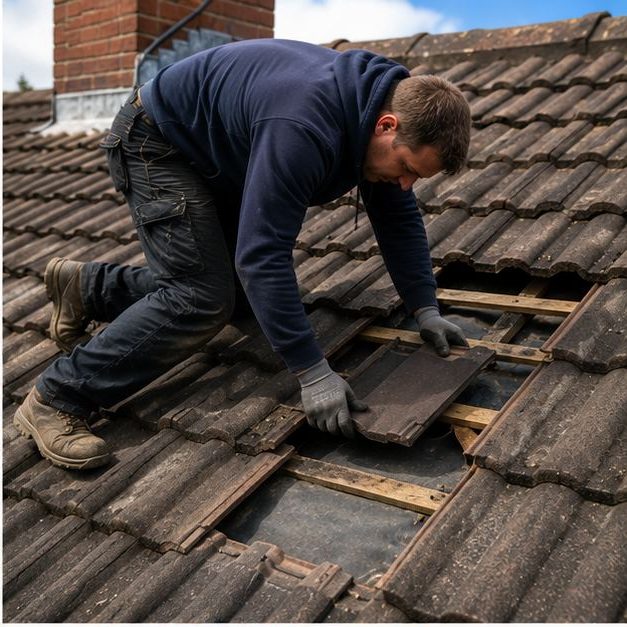
Where the pieces are sound, we lift them, clear the old fixings and any debris, and refix them to suit the system on the roof. Where they are cracked or the fittings are worn, we replace them. A dry-fixed ridge is re-fitted with the correct fixings rather than patched with filler, so it holds in wind.
- Remove loose or cracked ridge pieces
- Check the supporting timber and underlay beneath
- Refix or replace using the right fixings
- Seal and finish the ends and junctions neatly
Lead flashing repairs
Lead is dressed into the wall or chimney and over the tiles so water is led out and away. It fails where it lifts, splits, or the joint at the wall opens up. We cut out the failed section or renew the run, dress the new lead properly and make the upper edge secure. A bead of sealant alone is not a repair we rely on.
What to ask and what to expect
Ask what exactly has failed, what will be replaced, and whether the cause lies elsewhere. You should get a clear written description of the work and an explanation of what is urgent and what can wait. Some work, such as altering a chimney, may need planning or Building Regulations checks — we advise before work starts. Expect us to explain what is urgent and what can wait, so you are not pushed into work the roof does not need yet.
Frequently Asked Questions
Can a ridge be repaired without replacing the roof?
Usually yes. A loose or cracked ridge is a localised fault and can be put right on its own, provided the tiles and timbers below are sound. If we find the covering is failing more widely, we say so and explain the alternatives before anything is done.
How can I tell a flashing has failed?
From the ground you may see lead hanging away from a chimney or wall, or a dark stain on the wall below it. Inside, a damp patch near a chimney breast or party wall is a typical sign. Please call us rather than climbing up to look.
Is sealant a proper fix for a lifting flashing?
Sealant can slow water for a short time, but it is not a lasting repair for lead that has lifted or split. The proper fix is to renew or re-dress the lead so it is secured and sheds water by its shape.
Talk to our team about roof repairs in Emersons Green
Every roof is different — the fastest way to get an accurate answer is a quick chat with our team.