
A dry verge finishes the gable edge of a tiled roof without wet mortar. It is a simple idea, and it explains why newer estates are built with it.
The verge is the edge of the roof at a gable end, where the tiles stop and the wall begins. For a long time it was finished with a strip of mortar. A dry verge replaces that with fixed units. Planned estates like Emersons Green, with short verges and dry-fixed details, show how neat the result can be.
The problem with a mortar verge
Mortar sits on the edge tiles as a seal. It shrinks, cracks and works loose in wind and frost, and pieces fall off onto the path below. Once it opens, wind-driven rain, birds and insects can get in. The fix used to be to rebed it, and then repeat the job when it failed again. On a busy road or a short drive, falling mortar can also be a nuisance.
How the dry system is made
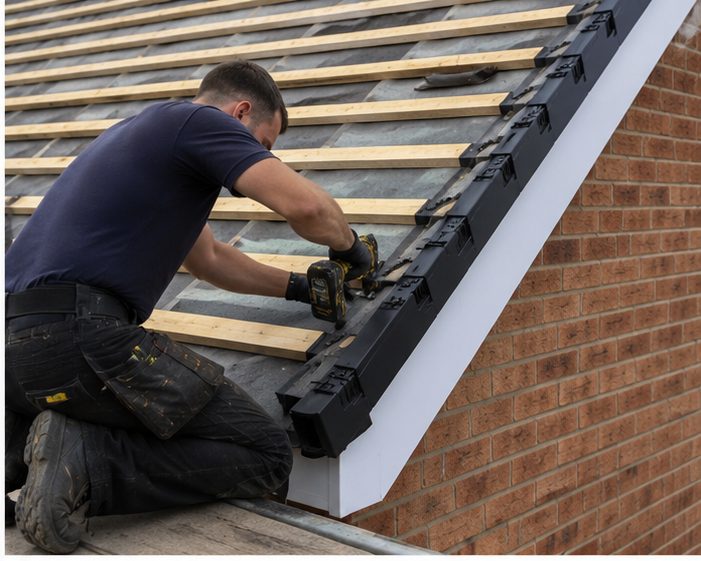
A dry verge uses purpose-made units that fit over or alongside the edge tiles and are fixed mechanically to the roof structure. Tile-end and cap pieces finish the line. There is no wet mortar, so there is nothing to crack. The units are fixed to the tile maker's guidance, using the fixings supplied for the system. Each unit locks into the next along the run, so the edge reads as one continuous line from the ridge down to the gutter.
- Verge units fixed along the edge of the roof
- Tile-end and cap pieces finishing the ridge junction
- Mechanical fixings instead of mortar
- A clean, even line along the gable
What it does for the roof
The main gain is wind resistance at the edge, where the roof is most exposed. Because the units are held down mechanically, there is less chance of a gust lifting the end tiles. It also keeps weather, birds and insects out of the roof space, and there is no mortar to maintain along the edge. The effect is a roof edge that stays tidy and weathertight through storms, with fewer return visits.
Where it fits best
It is the standard choice for new roofs and re-roofs, and it suits repairs where the old mortar has failed. Whether a particular system suits your roof depends on the tile profile, which we check on site. It is a good fit for the sort of concrete-tiled roofs found on modern estates.
What a dry verge will not fix
It will not cure a roof that is failing elsewhere. Slipped tiles, a loose ridge or a leaking flashing still need repair. We look at the whole roof, tell you which problems matter and which can wait, and say honestly whether a new verge is the right job to do first. A quick walk round the house tells us whether other faults are present.
Frequently Asked Questions
Does a dry verge need maintenance?
It needs very little, since there is no mortar to fail. It is still wise to have the roof edge looked at after a bad storm. We can check the fixings and the units as part of a wider inspection.
Is a dry verge less likely to blow off in wind?
The units are fixed mechanically along the edge, which gives better resistance than mortar. How well it performs depends on correct fitting and the tile type, which is why we follow the tile maker's guidance.
Can I tell from the ground if my verge is mortar or dry?
Often you can. A mortar verge shows a rough, cemented strip with a colour that differs from the tiles. A dry verge looks like a neat, uniform line of moulded units. If you cannot tell, we can confirm on a visit.
Talk to our team about dry verge systems in Emersons Green
Every roof is different — the fastest way to get an accurate answer is a quick chat with our team.