
The flat part of a roof is rarely where the water gets in. It is the edges, the walls and the upturns, where different parts meet. Here is why those details fail on Portishead flat roofs.
If a flat roof leaks, look at the details before blaming the middle. Edges and upstands are where a covering stops, turns up a wall or meets a trim. They move, they gather wind pressure and they take the first hit from rain. On exposed coastal roofs they fail first.
What an upstand actually is
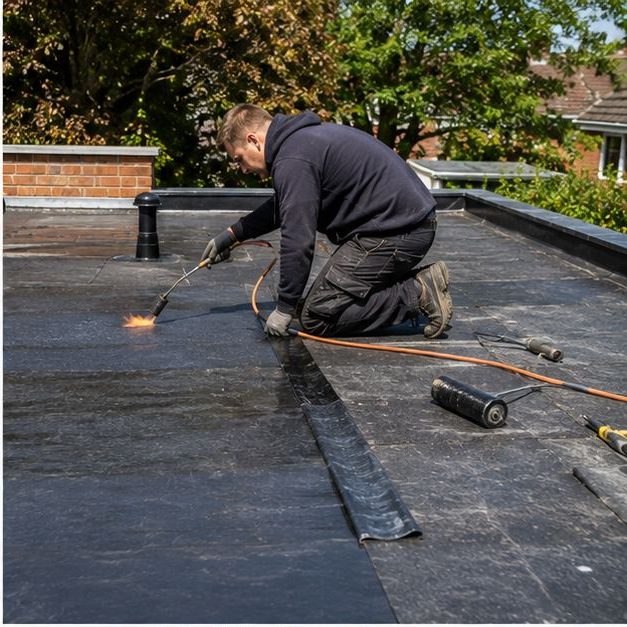
An upstand is the part of the covering that turns up where a flat roof meets a wall, a dormer cheek or a parapet. It is sealed at the top, usually under a flashing or into a joint in the brickwork. If that top edge opens, water runs behind and into the roof.
On a dormer cheek or the side of an extension, the upstand is often only a short strip of covering. A small failure there lets water run down the inside face of the wall, which is why damp can show up some distance away from the roof itself.
Why wind makes edges worse
The outer edge of a flat roof is where wind pulls hardest. Over time the covering can lift away from the deck, and the edge trim can loosen, leaving a gap rain is driven into. On exposed roofs near the estuary, this is a common starting point for leaks along a ceiling edge.
Other reasons joints open
Different materials expand and shrink at different rates, so seams at a wall or a trim slowly open. Old sealant dries and splits. Gutters that are blocked or set too high let water back up over the edge. Salt-laden air can also speed up the ageing of exposed trims and sealants.
- Edge trims that have loosened or bent
- Dried or split sealant at the top of an upstand
- Blocked outlets or gutters backing water up
- Corners and laps where the covering has pulled apart
How we repair them
We open up the failed detail, dry out what is wet, and rebuild the edge or upstand properly. That can mean refixing and sealing a trim, welding or bonding in a new upturn, or lead or flashing at the wall. A temporary smear of sealant is not a repair, and we say so.
Where we find the edge deck soft, that timber is cut out and replaced before the new trim goes on. Fixing a trim to rotten wood only holds until the next gale comes in off the water, so we do not skip that step.
What to look for and ask
Inside, look for staining along the ceiling beside the wall or edge, not in the middle of the room. From the ground, note drips or runs down the wall below the roof. Ask your roofer which detail failed, why, and what will be done differently this time.
Frequently Asked Questions
Why does my flat roof leak at the wall but not in the middle?
Because the wall joint is where two parts of the building meet and move, and where water naturally collects. A small gap in the upstand or flashing lets rain behind the covering even when the main surface is perfectly sound.
Can I seal an edge myself with sealant?
We would not advise it. Sealant on a failing joint usually traps moisture and hides the true problem, and climbing up to apply it is unsafe. A proper repair rebuilds the detail so water cannot get behind it.
Will fixing the edge solve every flat roof leak?
If the edge or upstand is the only fault, yes, it can. We check the rest of the roof at the same time so you know whether anything else needs attention, and tell you what is urgent and what can wait.
Talk to our team about flat roofing in Portishead
Every roof is different — the fastest way to get an accurate answer is a quick chat with our team.