
A dry verge is a way of finishing the edge of a gable roof without wet mortar. Here is what it is made of, how it stays in place, and why it suits windy coastal roofs.
The verge is the edge of your roof where it stops at a gable wall. For generations that edge was finished with a strip of mortar, which cracks and drops out. A dry verge does the same job with fixed parts instead. On breezy Portishead roofs, the difference shows.
The traditional problem
Mortar verges take weather from above and wind from the side. As the roof moves and the sand and cement weather, hairline cracks appear, then pieces drop off. Once that happens, wind can lift the edge tiles and rain and birds can get under them.
On older seafront houses the verge may have been repointed several times, each repair sitting on top of the last. That layering is part of why the edge looks heavy and still lets go after a stormy winter, even though it was mended not long ago.
What a dry verge is made of
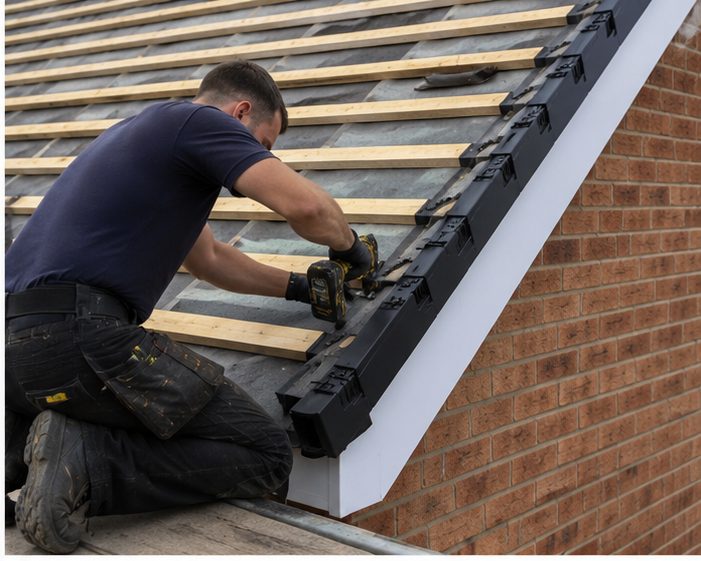
A dry verge uses purpose-made parts: a verge unit that runs along the gable edge and cap pieces that close the ends of the tiles. They are screwed or clipped to the roof structure, not stuck on with mortar. The finish sits neatly against the gable.
The cap pieces matter as much as the verge units. They finish the open end of each course of tiles so nothing is left exposed at the edge of the roof, which is exactly where a mortar verge tends to break up and let go first.
How it holds on in a gale
Because the units are mechanically fixed, they do not rely on a bond that can crack. That gives the roof edge a better grip against wind lifting from the side, which matters on exposed coastal sites. The fixing method follows the guidance from the tile maker for the roof in question.
Other everyday benefits
With no mortar to crack, there is nothing to fall onto the path below. The enclosed edge keeps out weather, birds and insects. It also needs little attention afterwards, unlike a mortar edge that needs periodic repointing. It can be used on new roofs, re-roofs, and repairs where mortar has failed.
Because it is mechanically held, a dry verge also copes better with the small movements that come with strong gusts. Where a mortar line cracks along its length and falls away, a dry verge simply flexes slightly with the roof and stays put.
- No wet mortar to crack, shrink or drop out
- Better resistance to wind lifting the roof edge
- Edge closed against birds, insects and weather
- Tidy finish that suits many common tile types
Checks before it goes on
Not every tile profile has a matching unit, so compatibility is checked on site. A dry verge also does not cure a roof failing elsewhere. We look at the whole roof, explain what is urgent and what can wait, and describe the work in writing before we begin.
Frequently Asked Questions
Is a dry verge the same as a mortar verge?
No. A mortar verge is bedded in wet mortar, which can crack and fall out. A dry verge uses fixed units and cap pieces with no mortar, so there is less to fail at the roof edge.
Does a dry verge keep birds and insects out?
No. A mortar verge is bedded in wet mortar, which can crack and fall out over time. A dry verge uses mechanically fixed units and cap pieces with no mortar at all, so there is much less to fail at the roof edge.
Is it only for new roofs?
No. It is fitted on new roofs and re-roofs, and also as a repair where old mortar has failed. Whether it suits a particular roof depends on the tile profile, which we check on site.
Talk to our team about dry verge systems in Portishead
Every roof is different — the fastest way to get an accurate answer is a quick chat with our team.