
Ridges and flashings take the worst of the weather, and in a coastal town they work hard. This guide walks through what a ridge re-bed and a lead flashing repair actually involve, step by step.
The ridge along the top of your roof and the lead around chimneys and walls are small parts doing a big job. When they fail, water gets in quietly. Portishead homes sit open to the estuary wind, so these details are worth understanding before anyone starts work.
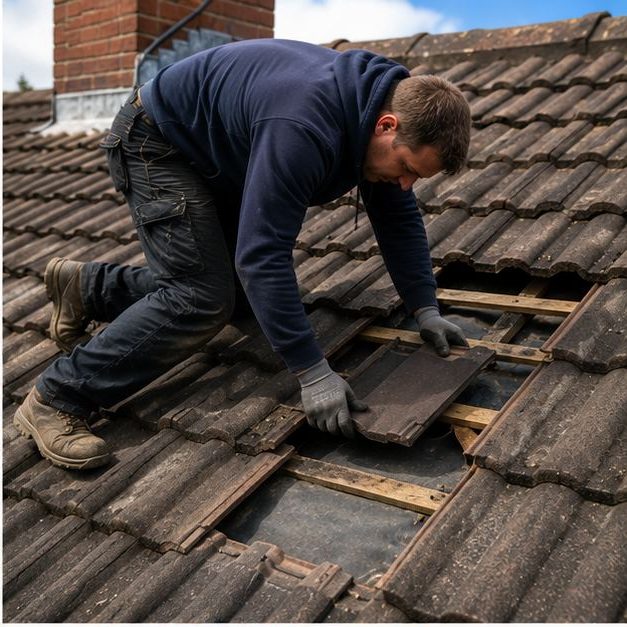
Why ridges and flashings fail
A ridge tile is bedded in mortar, and that mortar cracks as the roof moves with wind and changing temperature. Lead flashing seals the join between roof and wall, but it can lift, split or pull out of its joint. Sea air and strong gusts speed up both problems on exposed roofs.
Older roofs often have ridge mortar that has been patched more than once, and the layers hide how loose things really are. Looking from below is not enough to judge it; the tiles need lifting to see what is holding and what is merely sitting there.
Signs you may notice from the ground
You cannot judge these from the garden with certainty, but there are clues. Look for crumbs of mortar on paths, ridge tiles that look uneven against the sky, or lead that seems to hang away from a chimney. Inside, a damp patch near a chimney breast is a common sign.
- Pieces of mortar lying in gutters or on the drive
- A ridge line that looks wavy or has gaps
- Lead that seems lifted or loose at a chimney
- Damp marks on ceilings near chimney breasts
How a ridge is re-bedded
We take off the loose ridge tiles, clear the old crumbled mortar and check the tiles beneath for cracks. The ridge is then relaid on fresh mortar, or fixed mechanically where that suits the roof, and the joints are finished so they shed water. Any damaged ridge tile is swapped for a matching one.
Where a ridge is long or very exposed, we talk through fixing the tiles mechanically as well as bedding them in mortar. That helps keep them in place even if the mortar eventually weathers, and it suits a roof that gets plenty of wind.
How lead flashing is repaired
Where lead is sound but loose, it can often be refixed and dressed back into its joint. Where it has split or worn thin, we cut out the failed section or renew the whole run. Fresh joints are formed so water runs over the lead and onto the roof, never behind it.
Chimneys deserve particular attention because they have flashing on every face, and sometimes a tray or soakers as well. We check all of it, as repairing one side while another is worn only moves the leak somewhere else along the stack.
What to ask any roofer
Ask them to describe the repair in writing, explain whether it is a patch or a proper renewal, and say how they will reach the roof safely. A good roofer will also tell you honestly if the surrounding tiles or felt are the bigger problem. We work that way and are glad to talk it through.
Frequently Asked Questions
Can a cracked ridge be patched with more mortar?
Sometimes a small section can be repaired, but when mortar is crumbling along a length it is better to lift and relay that stretch. Patching over loose mortar tends to fail again quickly in exposed spots, so we judge it on site.
Is it worth renewing all the lead or just the damaged part?
If the rest of the lead is sound and well fixed, a local repair is often enough. If it is thin, lifting or has been patched before, renewing the full run makes more sense. We show you what we find.
Will repairs make a mess inside?
Ridge and flashing work is carried out from outside, so the interior is usually undisturbed. We may need loft access to check for damp timbers or felt, and we keep that tidy and tell you beforehand.
Talk to our team about roof repairs in Portishead
Every roof is different — the fastest way to get an accurate answer is a quick chat with our team.