
Not every flat roof that leaks is finished. The answer depends on what is under the covering and how widespread the damage is. Here is how we decide between repair and replacement on Portishead flat roofs.
Flat roofs on extensions, garages, porches and dormers take hard weather, and near the estuary that means wind, salt and heavy rain. When one starts to fail, the first question is always the same. Is a repair sensible, or are you better off starting again? It comes down to a few clear checks.
What a repair can sort out
A repair makes sense when the problem is local and the roof is otherwise sound. A single split, a lifted joint, a failed patch around a rooflight or a blocked outlet can usually be put right without touching the rest. The deck beneath has to be dry and firm for a repair to hold.
When replacement is the honest answer
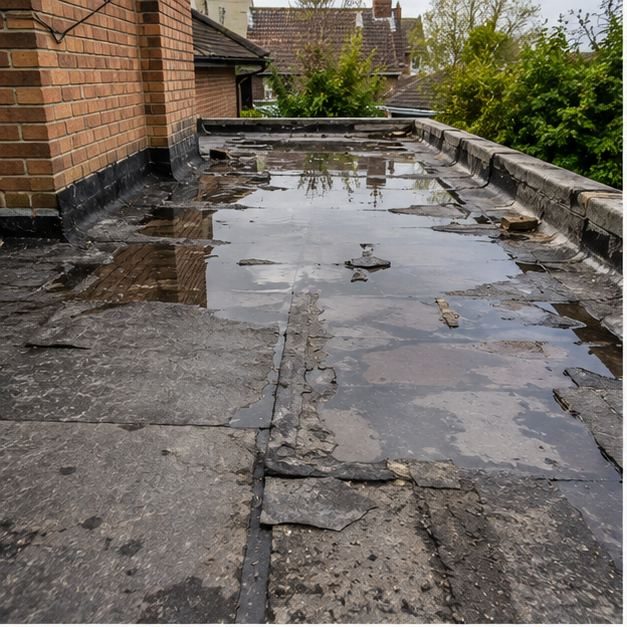
If the covering is cracked or blistered across much of the roof, if there are many old patches, or if water has got under it in several places, patching only chases the next leak. Wet insulation and a soft deck also point towards stripping back and starting afresh.
Honesty about limits matters here. We would rather tell you a roof still has some life left than replace something that only needs a proper fix, and equally say so plainly when patching would only be wasted effort and a second call-out later.
What we check before deciding
We look at the surface for ponding, blisters, splits and failed joints. We check the edges, the upstands where the roof meets a wall and the outlets. Where we can, we test whether the deck is sound. The loft or ceiling below often shows whether water has been getting in for a while.
- Standing water that stays long after rain has stopped
- Blisters, cracks and open joints in the covering
- Edge trims and wall upstands that have lifted
- A soft or spongy feel underfoot, noted from inside or by our own inspection
Coastal wear on flat roofs
Wind can lift edges and peel back covering that was not fully bonded, and salt air ages some materials faster. Roofs on older seafront houses often have several layers of past work. Many modern-estate extensions have simple, thinner coverings. Both can be repaired or renewed, but the starting condition differs.
Materials and getting a straight answer
If we replace, we talk through single-ply rubber, fibreglass and felt systems and which suits your roof. Ask for the repair or replacement option to be written down with what is included. Ask us to show you photographs of what we found under the old covering.
If a full replacement is the way forward, we look at insulation and falls at the same time. Improving the drainage as the new covering goes on stops the same ponding coming back and shortens nothing about how the roof performs.
Frequently Asked Questions
How do I know if my flat roof deck is rotten?
From inside, look for sagging ceilings, dark staining or a musty smell. We confirm by inspecting the roof and, if needed, opening a small section. Rotten deck must be replaced before any new covering goes on.
Is ponding always a sign of replacement?
Not always. Shallow ponding may just mean the falls are poor or an outlet is blocked. If the deck is sound, the covering can often be repaired or improved. Deep, persistent ponding with a sagging deck is a different matter.
Can a new covering go over the old one?
Sometimes, but only when the old roof is dry, firm and not hiding wet insulation. We check first. If there is moisture trapped below, stripping back to the deck is the safer course and we explain why.
Talk to our team about flat roofing in Portishead
Every roof is different — the fastest way to get an accurate answer is a quick chat with our team.