
The middle of a flat roof is rarely where the water gets in. Edges, trims and upstands are the weak points, and villa roofs have plenty of them. Here is why they fail.
Large houses in Sneyd Park tend to carry flat roofs in many places: rear extensions, porches, dormer tops, bay roofs and links between old wings. Each has edges and walls to meet. The covering across the middle may be perfectly good while a leak keeps returning at the perimeter, because that is where the detailing is hardest.
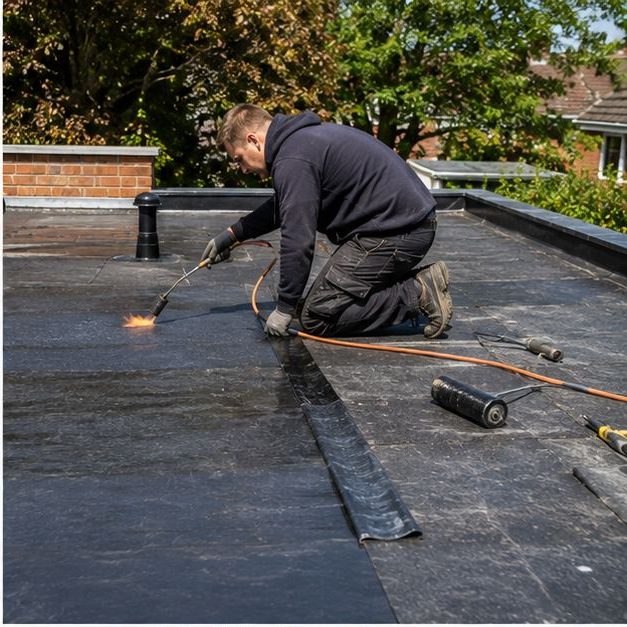
Where water gets in
The edges and upstands are where the flat covering ends or turns up a wall. Water can run under a lifted trim, behind a poorly sealed abutment or around a pipe or rooflight. Because it runs along the deck, it may emerge on the ceiling nowhere near the actual opening, which makes the source easy to misjudge.
Bay tops and dormer cheeks are common examples on villas: small areas, many angles and plenty of junctions. A leak there can be mistaken for a problem with the main roof slopes, which is why we trace the water carefully before suggesting any work.
Why upstands fail
An upstand is the covering turned up against a wall or kerb. It is held at the top by a flashing or sealed termination. Walls move, sealant ages and lead or trim pulls loose, leaving a gap at the very place where roof meets masonry. On old villa walls with crumbling pointing, the junction is often worse still.
- Covering that has pulled away from the wall
- Flashing or termination bar lifted or gapped
- Sealant cracked, shrunk or missing
- Pointing in the wall above failing
Edge trims and gutters
At the outer edge, a drip trim carries water into the gutter. If the trim is loose, bent or poorly lapped, water runs back under the covering and rots the deck edge. Blocked outlets and gutters filled by leaves from mature trees add to the problem, because water backs up and sits against the edge.
What we check and do
We trace the staining back across the deck, then inspect each edge, upstand and junction in turn. We press the deck near the perimeter for soft spots, and check outlets and gutters for blockage. Where the covering is sound, resealing or refitting the trim may be enough. Where the damage is widespread, we explain why a new covering makes better sense.
If the deck has been wet for some time, we tell you plainly, because replacing only the top covering over soft timber would be wasted effort. Where only a small area has gone, it can be cut out and renewed before the covering is repaired around it.
Questions worth asking
Ask whether the edge detail will be redone or just sealed over, and what will be done if rot is found in the deck. A proper repair deals with the cause at the junction. Ask also how the wall above will be checked, since a repair sitting against a failing wall will not hold long.
Frequently Asked Questions
Why does my flat roof leak when the middle looks fine?
Because the weak points are usually at the edges, upstands and penetrations. Water enters there, runs under the covering and appears indoors some distance away, so the middle can look perfect while the leak persists.
Can a failed upstand be repaired without replacing the roof?
Often, yes, when the covering across the roof is sound. The upstand is cleaned back, refixed and re-sealed or re-lapped properly. If the covering is tired and cracked everywhere, we recommend replacing instead.
Can leaves from nearby trees cause flat roof leaks?
Indirectly. Leaves block outlets and gutters so water backs up and sits against the edges and upstands, finding any weakness. Keeping outlets clear helps, and we check them whenever we look at a flat roof.
Talk to our team about flat roofing in Sneyd Park
Every roof is different — the fastest way to get an accurate answer is a quick chat with our team.