
A dry verge replaces the mortar at a gable edge with fixed units that hold the edge down mechanically. Here is how it works and when it suits a tall, exposed roof.
The gables of larger houses in Sneyd Park stand high and take wind coming across the gorge. The verge is the line of the roof at that gable, and traditionally it is sealed with mortar. A dry verge does the same job with purpose-made units fixed in place, so there is no mortar to crack, fall and leave a gap.
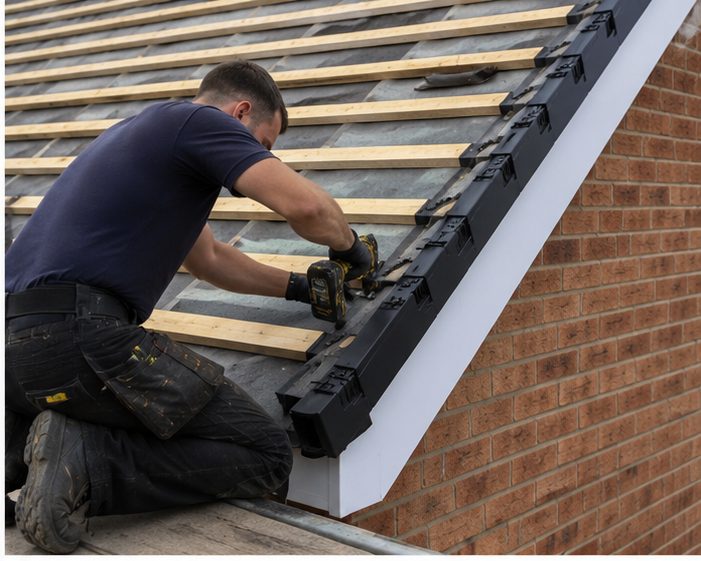
The verge and why it matters
The verge is the edge of the roof where it ends at a gable wall. The last tiles or slates run along it and must be held down and sealed against wind and rain. On a tall house the edge is exposed, so any weakness in how it is finished shows up quickly, and can let weather in under the covering.
How a dry verge is built
Rather than bedding the edge in wet mortar, a dry verge uses units fitted along the edge and screwed or clipped to the roof structure. Tile-end or cap pieces finish the line. Because everything is mechanically fixed, it resists wind lift and stays put, and it keeps birds, insects and weather out of the gap.
- Verge units fixed mechanically along the edge
- Tile-end or cap pieces finishing the line
- No wet mortar to crack or crumble
- Fitted in line with the tile maker's guidance
What it does well
The main gain is that the commonest point of failure, the mortar, is gone. Nothing crumbles onto paths or drives. The edge stays tidy and sealed through hard weather, and the wind has less to work on. It suits new roofs, re-roofs and repairs where an old mortar verge has failed.
What it will not do
A dry verge is not a cure for a roof failing elsewhere. Worn slates, tired flashings or perished felt will still leak with new verge units in place. Compatibility also depends on the tile profile, which we check on site before agreeing it. Where a system does not suit, we say so and explain the alternatives.
Falling mortar on a path or drive is often the first sign that an existing verge is failing, and it is a good moment to have the whole gable edge looked at by someone who can see it up close, not just from the lawn.
Fitting and care
Fitting needs safe, planned access to a high gable, with the old mortar removed and the edge checked as the work goes on. Afterwards little is needed beyond a look from the ground now and then. A new roof edge may need planning or Building Regulations checks — we advise before work starts.
We also look at the bargeboard or edge below the verge while the work is under way, because it is far easier to deal with a weak board at that point than to return later and set up access a second time.
Frequently Asked Questions
Is a dry verge suitable for every roof?
No. The units are made for specific tile profiles, so compatibility is checked on site. Some older roofs need a different approach, and we say so plainly if a dry verge is not the right fit.
Will it change how the gable looks?
The line is usually a little different from a mortar finish, but it is neat and consistent, and it keeps its shape. We explain what to expect for your tile before you decide.
Does a dry verge need maintenance?
Very little. With no mortar to crack, there is nothing to repoint. A look from the ground after severe weather, and keeping the area below clear of debris, is generally enough, and you can call us if anything looks loose or out of line.
Talk to our team about dry verge systems in Sneyd Park
Every roof is different — the fastest way to get an accurate answer is a quick chat with our team.