
Extensions to big villas ask more of a flat roof than a simple garage does. We compare the main materials and explain what decides which one suits your house.
An extension on a Victorian or Edwardian villa in Sneyd Park rarely has a plain, simple roof. It meets tall brick walls, often has rooflights or a parapet, and may sit under overhanging trees. Single-ply rubber, fibreglass and felt systems can all work. The right pick depends on the shape and the detail, more than on the product name.
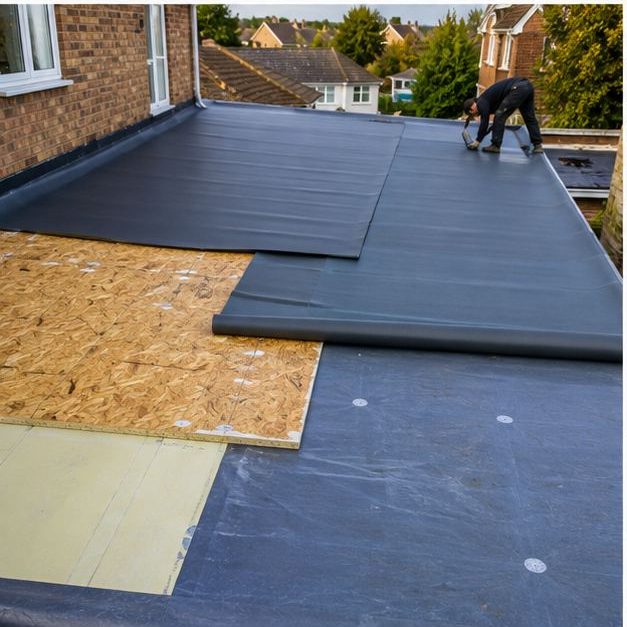
Single-ply rubber
EPDM arrives as a large flexible sheet, so a straightforward rectangular roof can be covered with very few joints. It adapts well to small movement between the extension and the old wall. It is dressed up walls and around outlets with purpose-made pieces, and suits roofs that are open and uncomplicated.
Fibreglass
GRP is formed on site as one continuous skin, so it copes well with awkward shapes, corners, rooflight kerbs and parapet edges where a sheet would need many joints. It is hard-wearing underfoot. It needs a stable, well-prepared deck and well-made trims, since the quality of the result depends on the substrate and the detailing.
Because it sets hard, it is less forgiving of movement in the structure, so we look at how the extension is tied to the house before suggesting it. Edge trims and corner detailing are where a fibreglass job succeeds or fails, and we talk through those with you plainly.
Felt systems
Modern felt is laid in layers with sealed joints. It suits many roofs and is familiar to most roofers, which makes later repair straightforward. How it performs depends largely on the quality of the lapping and the upstand work, so it is a good choice only where the roofer takes real care over detail.
- Roof shape and the number of corners
- Rooflights, pipes and other penetrations
- Condition of the deck and its falls
- Tree cover and exposure to wind
Insulation and the build-up
Whatever the covering, the layers beneath count: the deck, the insulation, the vapour control and the falls that carry water to an outlet. Poor detailing here causes condensation and ponding. We explain how the roof will be built up, and why, so you can follow what goes into the structure.
On a villa extension, the joint with the older brick wall is the detail we spend longest on, because the old wall and the new roof move at different rates and the junction has to allow for that without opening up.
Questions before you decide
Ask how the deck will be checked, how water will drain, and how the junction with the old wall will be finished. Ask how outlets will be protected from leaf litter. A new extension roof may need planning or Building Regulations checks — we advise before work starts. Choose the roofer for how they explain these details.
Frequently Asked Questions
Is one flat roofing material always best for an extension?
No. Each performs well on a sound deck with good falls and careful detailing. The roof's shape, penetrations and exposure decide which suits best, and the quality of the installation matters more than the product.
Which material copes best with awkward shapes?
Fibreglass is often chosen where a roof has many corners, rooflights or parapets, because it forms a continuous surface. Others can work too with careful detailing, which is why we look at the roof in person.
Does tree cover affect the roof material?
Not so much the material as the maintenance. Leaves block outlets and gutters, so access for clearing and well-protected outlets matter. We think about this when advising on the layout and the falls of the roof.
Talk to our team about flat roofing in Sneyd Park
Every roof is different — the fastest way to get an accurate answer is a quick chat with our team.