
Some fascia boards can be saved with careful repair, and others are past it. We explain how we decide on a tall villa with long eaves, and what replacement involves.
Victorian and Edwardian villas in Sneyd Park have long runs of eaves, often high above sloping gardens, and the fascia boards along them take weather from every direction. Repairing a board is sometimes sensible and sometimes just delays the inevitable. The decision turns on how deep the damage goes and what lies behind the board.
When repair is reasonable
A repair suits a board that is mostly sound, with damage confined to a short section, such as a split joint, a small patch of soft timber or a loose fixing. If the rafter ends behind are dry and firm, cutting out and renewing the affected piece, then refitting the gutter properly, can be an honest and sensible solution.
When replacement is better
Replacement is the better route when rot runs along most of the board, when paint is failing everywhere, or when repaired sections keep breaking down. Long eaves on a large house mean scaffold is a big part of any job, so renewing a failing run in one go often makes more sense than returning to patch it.
- Soft timber along much of the board length
- Repeated splits or joints opening up
- Gutters that will not stay fixed to the board
- Rafter ends damp or marked behind the board
What replacement involves
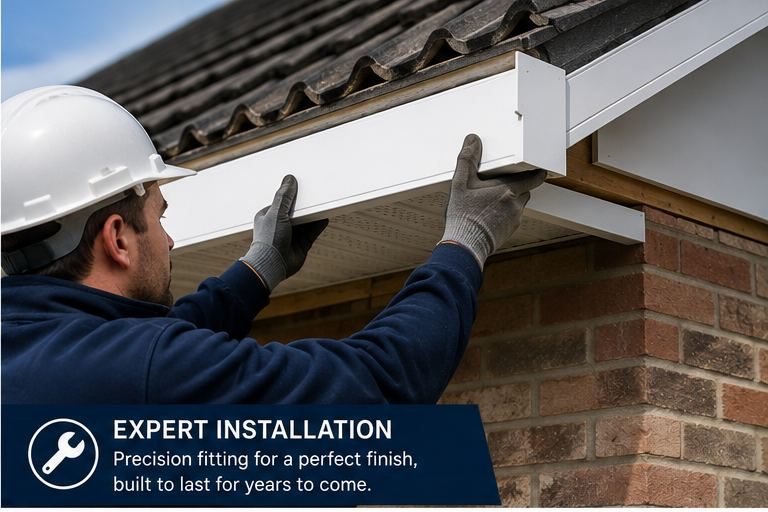
We take off the gutters and old boards, then inspect the rafter ends and eaves before anything new goes on. New UPVC fascias and vented soffits are fitted, with vent strips so the roof space breathes, and the gutters are refitted or replaced. White is standard, with darker and wood-effect finishes available. UPVC is cleaned, not painted, and is very low maintenance.
Older houses and soffit boards
On older homes we check what existing soffit boards are made of before disturbing them, and we handle them accordingly. It is a calm, routine part of the job, and it comes before any boards are taken down so the work is planned with the right approach from the start.
Mature trees close to the eaves add leaf litter to gutters, so we look at how clear the gutter runs are and whether they are the right size and fall for the roof they serve. A sound gutter protects new boards from the first day.
Questions to ask
Ask whether the rafter ends will be inspected, whether the soffits will be vented, and how the gutters will be handled. Ask who arranges the scaffold and how the garden below will be protected. A clear answer to each tells you whether the job is being planned properly, whether repair or replacement is on the table.
Frequently Asked Questions
Can I just repaint a rotten fascia?
Paint will not cure rot. Soft timber needs cutting out or replacing first. Painting over damp or soft board hides the damage for a while but lets it carry on underneath, so we look at the board's condition first.
Is UPVC always better than timber?
UPVC is very low maintenance and does not rot, so it removes the repainting cycle. Some owners of period houses prefer timber for its look. We talk through both, and what each involves, before you decide.
Do I need scaffold for fascia work?
Almost always, on a house of this size. Safe access to the eaves is needed to remove boards, check rafter ends and refit gutters properly, and it forms part of how the job is planned.
Talk to our team about UPVC fascias and soffits in Sneyd Park
Every roof is different — the fastest way to get an accurate answer is a quick chat with our team.