
There is no safe waiting period for a leak. Damage starts quietly inside the structure, long before a stain reaches the ceiling, and tall Cotham houses hide it well.
A leak does not wait for a convenient moment. Water starts working on timber, plaster and insulation from the first wet day, and in a tall Victorian house the first sign you see is often the last stage of a long journey. How quickly it matters depends on where the water enters and what it lands on.
What the water does before you see it
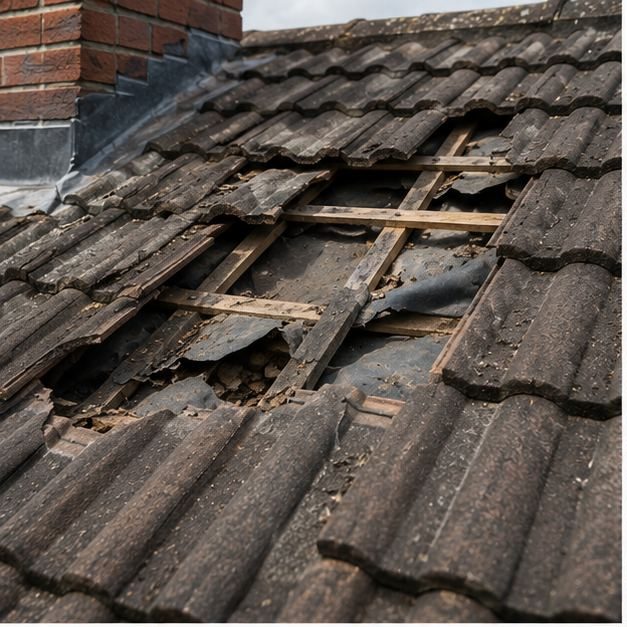
Rain that gets past a tile, slate or flashing runs along the felt and down the sides of rafters before it drips. Timber takes it up, insulation holds it like a sponge, and the stain on a ceiling appears well away from the real opening. By then the structure above has usually been damp for a while, so a small stain should never be read as a small problem. Staining that spreads or returns after drying is a sign the water is still coming in.
Why tall villas and terraces hide problems
Cotham houses are tall, with deep roof voids, parapet gutters and big chimney stacks. A parapet gutter that spills sideways or a failed lead flashing around a stack can soak a wall or the top-floor ceiling slowly, with nobody noticing. In houses split into flats, the person who sees the damp may not be the one who owns the roof, which slows down getting it looked at. Tell whoever manages the building as soon as you notice anything.
What gets worse the longer it is left
The cost of waiting shows up in what has to be dealt with later, not only in the original opening. A repair that would have been small becomes a bigger one once these start to appear, and each of them is harder to put right than the leak that started it.
- Rafter ends and wall plates that stay wet long enough to soften
- Damp insulation that stops doing its job
- Plaster that blows, stains and eventually drops
- Mould on top-floor ceilings and chimney breasts
- Electrics near the wet area becoming a hazard
What we check when you call
We look from the ground first, then at the roof itself, paying attention to lead work, the parapet gutter, chimney flashings and any slipped or cracked coverings. Inside, we check the loft or top-floor ceiling for daylight, dark timbers and stained felt. Then we tell you where the water is getting in, how far it has gone and whether anything is urgent. You get a plain explanation, not a sales pitch.
What you can do while you wait for us
Stay on the ground and inside. Put a bucket under any drip, move furniture and bedding out of the way, and keep a note of when it happens, such as after wind-driven rain or only in heavy showers. Photographs of stains help us. Do not go up to look yourself or try to seal anything from outside; a proper look from us is safer. Switch off lights near any wet ceiling.
Frequently Asked Questions
Is a slow drip really urgent?
A slow drip is still water getting into timber and insulation, and it rarely stays slow. It may not need an emergency response, but it should be looked at promptly, because the damage grows the longer the structure stays wet.
My leak stops when the rain stops. Is it fixed?
No. Timber and felt hold water and release it slowly, so a leak can seem to stop while the opening is still there. The next heavy or wind-driven rain will bring it back, usually in the same area.
Who deals with a leak in a converted building?
Usually the roof belongs to the freeholder or is shared between flats, so the owners need to agree who instructs the work. We can look at the roof, explain what we find in plain terms and give you something clear to pass on.
Talk to our team about roof repairs in Cotham
Every roof is different — the fastest way to get an accurate answer is a quick chat with our team.