
There is no safe waiting period for a leak, because the damage starts the first time water gets past the covering. What matters is how much water, where it goes and how quickly it is found.
Most homeowners in Yate spot a leak when a ceiling stain appears, and by then the water has usually been working for a while. The honest answer to how long a leak can wait is that it depends on the route the water takes, the weather and what it is soaking. Here is how we think about it.
Why the stain is not the start
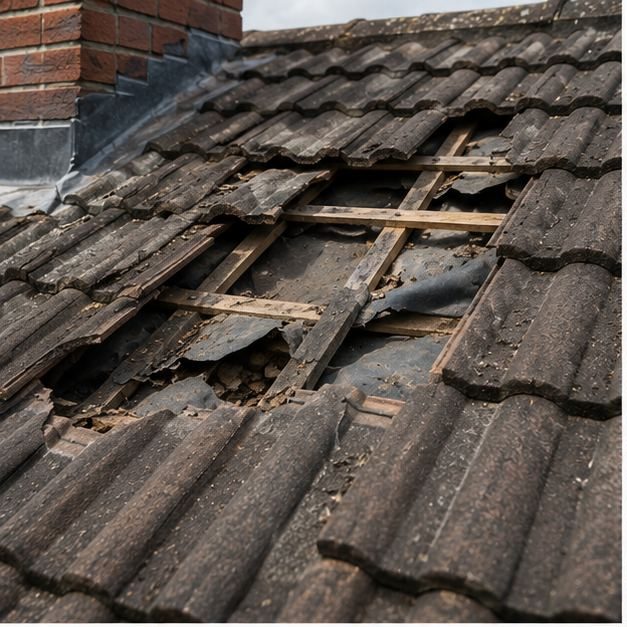
The mark on the ceiling is where water finally gave up and dropped through, not where it came in. On the concrete tiled roofs common across Yate's later estates, water can run along battens and felt for some distance first. By the time you see it, timber and insulation above may already be wet. Rainwater needs only a hairline gap when wind drives it sideways.
What decides how fast it gets worse
A steady drip in wet weather is different from a trickle only in driving rain. The size of the gap, how often the weather hits that side of the house and what sits underneath all change the picture. Insulation holds water like a sponge, and damp timber stays damp for a long time. Short gaps between dry spells do not give timber time to dry fully, so repeated wetting does more harm than a single soaking.
A small leak in a dry spell can look harmless. It is not telling you the roof is fine, only that it has not rained hard enough yet, and the timbers can be taking in moisture quietly meanwhile. Repeated wetting between dry spells does more harm than one soaking.
Signs it is already doing harm
You can check these from inside, with no need to go near the roof itself. Do the loft check from the hatch, with a torch, keeping to the joists and not stepping between them. If anything looks wet, dark or sagging, photograph it and call us for a proper look.
- Brown rings or bubbling paint on ceilings, especially near external walls.
- A musty smell in the loft or the room below.
- Dark, damp-looking rafters or felt when you look in with a torch.
- Insulation that looks flattened, clumped or wet to the eye.
- Black mould spotting in corners of upstairs ceilings.
What to do while you wait for us
Put a bucket under the drip, move belongings and switch off any light fitting that is wet or near the stain. Take a few photos of the ceiling as it changes. If a ceiling is bulging, keep clear of that room and call us straight away. Do not go onto the roof yourself; we will take a proper look from the right access. If the ceiling is dripping badly, tell us when you ring so we can plan make-safe work first and the full repair afterwards.
What we do when we get there
We trace the leak back to its real source, which in an estate house is often a cracked tile, a worn ridge bed or a tired flashing round a porch or garage roof junction. We explain what we find, what is urgent and what can wait, then repair it properly. Where the covering is tired across the board, we say so honestly. Afterwards you get a plain account of the cause.
Frequently Asked Questions
Can I just wait until the weather improves?
A dry spell hides the problem but does not fix it. Any damp already in the timbers and insulation stays there, and the next heavy rain finds the same gap. Booking a look sooner usually means a smaller repair.
Will the leak stop on its own?
It rarely does. Gaps in a covering do not close up, and water follows the same path each time. A leak that seems to stop is normally just waiting for the right wind direction and rain.
Should I tell my insurer or sort the roof first?
That is your call, but get the roof made weathertight first and keep photos of the damage as it appeared. We can tell you in plain terms what we found and what the repair involved, in writing if you ask.
Talk to our team about roof repairs in Yate
Every roof is different — the fastest way to get an accurate answer is a quick chat with our team.