
A garage flat roof replacement is a strip, check and rebuild job, and the quality sits in the parts you cannot see afterwards, like the deck, the falls and the edges.
Plenty of Yate homes have an integral or attached garage with a flat roof that has simply been left until it leaks. Replacing it is a tidy job with a clear sequence. Knowing the sequence helps you compare quotes properly and spot what a thin, covering-only proposal leaves out.
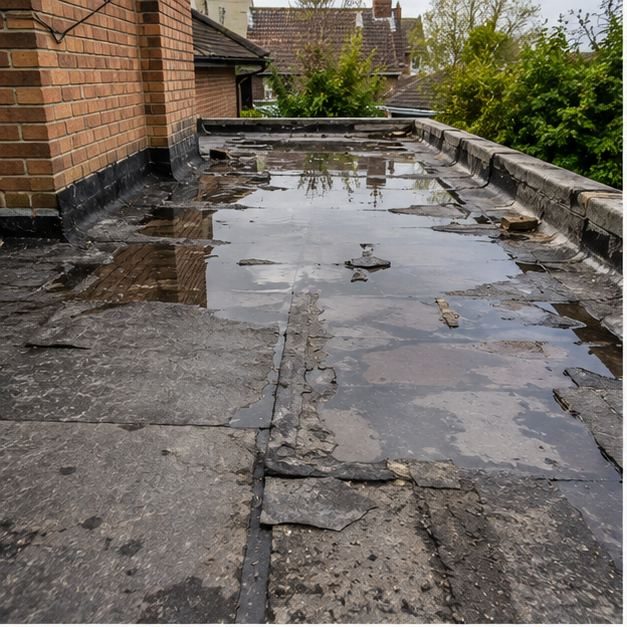
A look before anything is stripped
We start with a close look at the existing covering, how water leaves the roof and where it meets the house wall or neighbouring roof. We check the ceiling inside for stains and the garage for damp. That tells us whether the problem is the covering only or something underneath, and lets us explain the likely scope clearly. Ask the person quoting whether they have looked at the ceiling inside and the roof edge, not only the top surface.
Stripping and checking the deck
The old covering comes off and the boards underneath are exposed. This is where hidden rot shows, usually around joints, outlets and wall edges where water has sat for a long time. If the ceiling below shows staining, the deck is the likely culprit and we plan for repair from the start.
Any damaged deck is cut out and replaced rather than covered over. Covering soft boards just hides the problem for a short time and the new roof then fails early. Ask the person quoting whether they looked at the ceiling inside as well as the top surface of the roof.
Falls, insulation and the layers
Flat roofs need a slight slope so water leaves instead of standing. If the existing falls are poor, we can correct them with tapered boards or firring. If the garage is heated or attached to living space, insulation and a vapour layer may be worth discussing. Some changes may need planning or Building Regulations checks — we advise before work starts.
- Deck repaired or replaced where it has gone soft.
- Insulation and vapour layer fitted if appropriate.
- Waterproof covering laid in a system suited to the roof.
- Upstands, flashings and edge trims detailed properly.
- Outlets and guttering checked and cleared.
Choosing the covering
Single-ply rubber, fibreglass and felt systems all have a place. Rubber suits a large, plain roof, fibreglass copes well with awkward shapes, and felt can suit certain budgets and layouts. We explain the trade-offs for your garage rather than pushing one product, and say what each means for edges and joins. Ask how the edge trim and the join with the house wall will be dealt with, as those are the parts that tend to let water in.
Finishing and tidying
The edges, drip trims and wall junctions are where most flat roofs fail later, so they get the attention. We then clear the site, leave gutters flowing and run through what was done. Ask for a written description of the work so you can see what was included and what was not. A written description of the work is worth having, so you can see that deck repair, insulation and edges are covered and not left as extras.
Frequently Asked Questions
Can the old covering stay as a base?
Sometimes, if it is dry, flat and well fixed, but in most garage replacements we strip it so we can inspect the deck. Layering over damp or soft material hides faults and shortens how well the new roof performs.
Will the garage be unusable during the work?
Usually you can still get to most of it, but we will tell you about vehicles, access and any day when the roof is open to the weather. We plan around the forecast to keep that short.
Is a repair ever enough instead?
Yes, where the covering is sound over most of its area and the problem is local, such as a split at an edge. If the damage is widespread or the deck is rotten, replacement is the honest answer.
Talk to our team about flat roofing in Yate
Every roof is different — the fastest way to get an accurate answer is a quick chat with our team.