
A Victorian or Edwardian roof is rarely finished just because it is old. We explain how we weigh up a repair against a full re-cover on a large, exposed villa.
Many Sneyd Park houses are large Victorian and Edwardian villas whose roofs have seen decades of weather coming off the gorge. Age alone does not settle the question. A well-laid roof can be repaired and carry on for a long time, while a tired one eats money in repeat visits. The judgement rests on what the roof is actually doing.
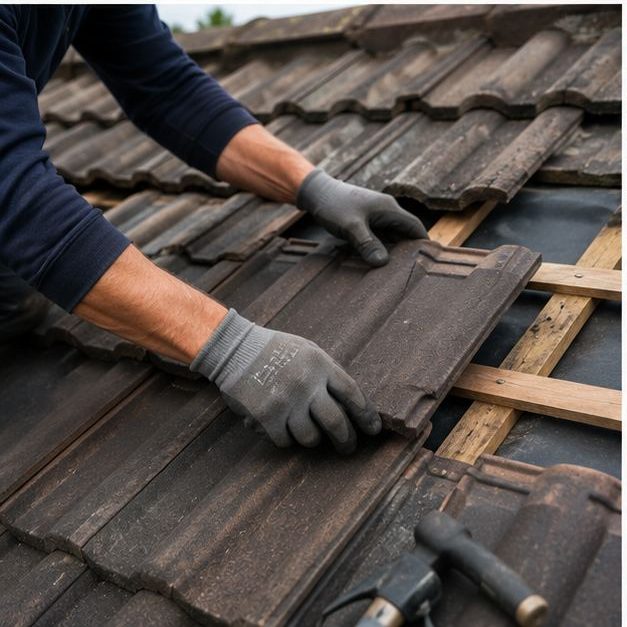
What a repairable roof looks like
A roof worth repairing has faults that are few, local and clearly linked to a cause. Perhaps a run of slipped slates after wind, a cracked ridge, or a flashing at one chimney. The rest of the covering is firm, the battens are sound and the loft is dry. In that case, targeted work protects the roof without needless expense.
What a worn-out roof shows
Replacement comes into view when faults keep spreading. Slates that are delaminating or breaking as they are lifted, fixings rusting through, battens that are soft and felt that is brittle or missing all point towards the end of the roof's working life. Repairing one slope then simply exposes the next weak area.
- Slates or tiles crumbling, flaking or splitting
- Nails rusted through so coverings slide
- Battens that are soft, dark or sagging
- Large areas of felt torn or missing
Why big, tall roofs are different
Large villa roofs have long runs of ridge, many valleys and several chimneys, which multiplies the detail that can fail. Mature trees nearby drop leaves and branches that fill valleys and gutters, and damage coverings. Because access is demanding, it often makes sense to deal with all the weak points in one visit rather than returning repeatedly.
Where trees overhang, we also check for branch damage and for valleys choked with leaves, because both can make an old roof look worse than it is, or hide a real fault underneath. A clear valley and clean gutters often change the picture quite a lot before any covering is touched.
The honest comparison
We set out what a repair would cover, how long it is likely to hold in terms of what it depends on, and what a re-cover would involve. Often the answer is a repair now with a plan for later. Sometimes it is replacing one slope only. We say plainly which route makes sense and why.
A repair is not a lesser answer when the roof is basically sound, and a re-cover is not an upsell when it is not. We would rather give you the evidence from the loft and the slopes and let you weigh the choice yourself.
Questions to ask any roofer
Ask for a written description of the problem and each option, so you can compare them. Ask what evidence supports the advice, and to be shown the loft side of the roof. A roofer who explains what is urgent and what can wait is giving you the information to decide for yourself, which is what you should expect.
Frequently Asked Questions
Can part of a Victorian roof be replaced on its own?
Yes, often. If one slope is worn and the other sound, we can re-cover the worn slope. Care is needed at the ridge, hips and edges so old and new meet cleanly, and we look at the whole roof first.
Is it worth keeping the original slates?
Where they are sound, reusing them can suit the character of the house. Slates that are breaking or crumbling are not worth refixing. We check them closely before advising, and tell you how many can be kept.
What does the loft tell you about the roof?
A great deal. Daylight, wet or stained timbers and perished felt show where water gets in and how far the damage has spread. It is one of the first places we look before giving any opinion.
Talk to our team about roof repairs in Sneyd Park
Every roof is different — the fastest way to get an accurate answer is a quick chat with our team.