
A failing fascia board is more than a cosmetic fault. On a large villa it can lead water into the eaves and roof space. Here is how that happens and what we check.
With tall Victorian and Edwardian roofs, damaged fascias in Sneyd Park are easy to overlook, since they sit high above the garden and look much the same from a distance. But the board carries the gutter and shelters the rafter ends. When it fails, the effects spread into the roof, and they can go unnoticed for some time.
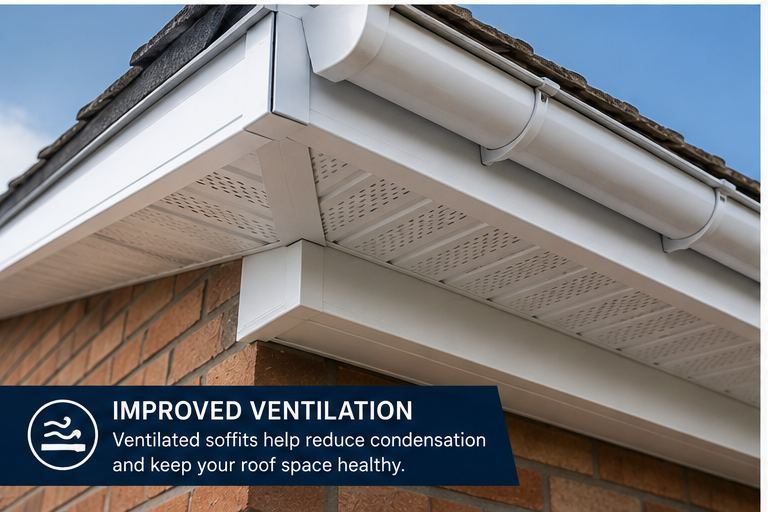
What the board is protecting
The fascia runs along the ends of the rafters and holds the gutter. Beneath the overhang, the soffit closes the underside of the eaves. Together they keep weather out and let the roof space breathe. Damage to either exposes the timber behind to rain, birds and insects, and the whole edge of the roof becomes vulnerable.
On a large villa the eaves run a long way and sit high, so a fault at one corner can go unseen from the garden. That is why a slow drip into a rafter end can carry on for a long time before anything shows inside.
How trouble builds
Water behind a failed board soaks rafter ends and the bottom of the roof covering. The lowest tiles or slates lose support and can slip. Gutters fixed to soft board sag, so rain overshoots and runs down the wall. Leaf litter from mature trees makes the overflow worse by blocking the gutter outlets.
- Gutters sagging or overflowing in heavy rain
- Staining on the walls beneath the eaves
- Slipped slates or tiles on the lowest course
- Birds or wasps using gaps at the roof edge
What we look for
We look at the line of the boards, joints, paint or surface, gaps and stains, then at the gutters hanging from them. Where access is arranged, we inspect rafter ends and the underside of the eaves. We pay attention to the exposed elevations, which tend to wear first, and to any section close to overhanging branches.
Repair, replace and ventilate
Minor faults may be dealt with locally. Widespread damage needs new boards, new vented soffits and refitted gutters, with scaffold for safe access. UPVC is very low maintenance and only needs cleaning. On older houses we check what existing soffit boards are made of before disturbing them. Good ventilation at the eaves keeps the roof space dry.
Why not wait
Fascia faults tend to progress, because wet timber stays wet and soft timber gets softer. Dealing with a failing board early usually means a shorter job and less hidden damage. Waiting often turns a few boards into a full run, and brings rafter ends and roof coverings into the picture as well.
A short, honest look from us costs you nothing in effort, and tells you whether the boards are simply ageing or are already letting water into the roof edge, so you can plan the work calmly rather than react to a leak.
Frequently Asked Questions
Can a bad fascia cause a leak inside the house?
Yes, indirectly. Water behind a failing board can soak rafter ends and run into the roof space or onto ceilings and walls, and a sagging gutter can push rain under the bottom row of slates.
How do I check my fascias safely?
From the ground, look for sagging gutters, peeling or dark boards, gaps at joints and stains on the walls below. Do not use a ladder against the roof edge. Call us and we will look properly.
Do soffits need replacing at the same time?
Often yes. They work as a pair at the eaves, and one failing usually means the other is not far behind. Replacing both together is neater, uses one scaffold and allows proper venting to be fitted.
Talk to our team about UPVC fascias and soffits in Sneyd Park
Every roof is different — the fastest way to get an accurate answer is a quick chat with our team.