
A tile does not slip for no reason. Age, weather, movement and old repairs all play a part, and on terraced roofs one loose tile often points to others.
Tiles are held by gravity, nibs and a few nails, and over time those fixings tire. In Ashley Down, rows of Victorian and Edwardian terraces and inter-war semis carry roofs that have seen many winters. A slipped tile is a small thing to look at but can let water in, so the cause matters as much as the cure, and it is worth understanding before anyone starts patching.
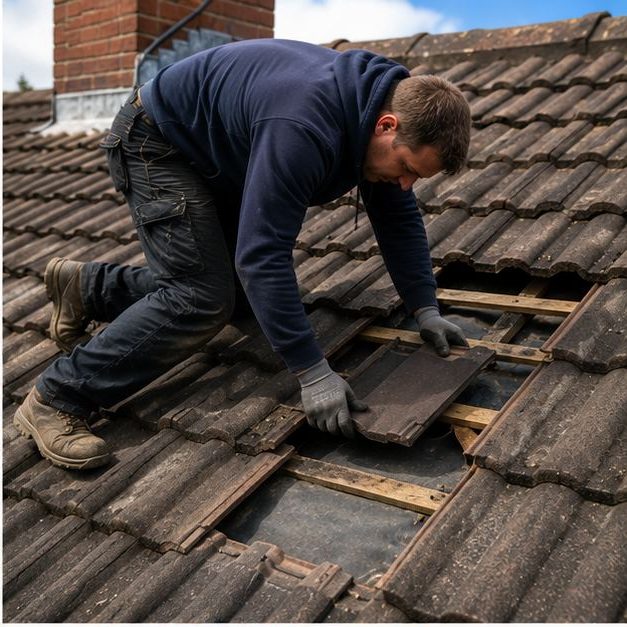
Why tiles slip out of place
Most tiles hang from battens by a nib and are held by occasional nails. Nails rust, battens dry out and shrink, and the tile loosens until a gust or a heavy shower nudges it downhill. Birds and squirrels disturb them, and so does old, badly done repair work. A single slipped tile commonly signals that the fixings around it are also tired.
Why tiles crack
Clay and concrete tiles crack for several reasons. Frost can split a tile that has soaked up water, and something heavy landing on the roof can crack one outright. Walking on a roof is a common cause, which is one reason we ask owners not to go up. Age makes tiles brittle too, and cracks are often hairline until rain finds them. Tiles that have been moved or replaced badly in the past are more likely to crack again, because they never sat quite right.
Where the pattern shows on terraces and semis
Dense terraces share roofs, party walls and gutters, so a fault on one house can affect its neighbour. Bay-fronted houses add small roofs with valleys and lead where water collects, and rear extensions create junctions between old and new tiling. Those meeting points often show slipped tiles first. We look along the whole roof line, not just the visible gap.
- Gaps or dark patches in the tile pattern
- Fragments of tile in the gutter or garden
- Tiles sitting visibly out of line from the street
- Daylight or damp marks in the loft
What we check and how we fix it
From the loft we look for daylight and damp, then inspect the roof. Slipped tiles are refixed, cracked ones replaced with matching tiles, and nearby fixings checked at the same time. If the battens are rotten, we deal with them before relaying. We also check the ridge, verge and lead flashings, because tile movement near those points often hides a bigger fault.
When it is more than a few tiles
If tiles are slipping widely across a slope, the problem is the fixings, battens or felt, not the individual tile. Repairs then become a poor use of money and a partial or full re-roof may be the honest answer. We explain what we found, show photographs, and say what is urgent and what can wait. Call us for a proper look rather than watching the gaps grow.
Frequently Asked Questions
Can a slipped tile cause a leak straight away?
It can, particularly in wind-driven rain, because the felt underneath is then the only barrier. A short-term delay is sometimes fine, but gaps get bigger and the felt beneath ages in the weather, so it is sensible to have them looked at promptly.
Will replacement tiles match my old ones?
We aim for the closest match in shape, size and colour. Older tiles weather, so a new one may look slightly different at first. Sometimes sound tiles from a less visible slope can be reused.
Is it safe to look for slipped tiles myself?
Please stay on the ground. Binoculars from the garden or street show a lot without any risk. For anything closer, call us for a proper look, and we will explain what we see.
Talk to our team about roof repairs in Ashley Down
Every roof is different — the fastest way to get an accurate answer is a quick chat with our team.