
After a blow, the first hours are about staying safe, limiting water getting in and recording what you can see from the ground. This guide covers each step for Horfield homes, from terraces to extensions.
Strong wind rarely damages a roof evenly. It lifts the weakest points first: ridge lines, edges, flashings and anything that was already loose. In Horfield the mix of older terraces, inter-war semis and later extensions means several different roof types can be hit in one street. Here is what to do, what to leave alone and what we look at when we arrive.
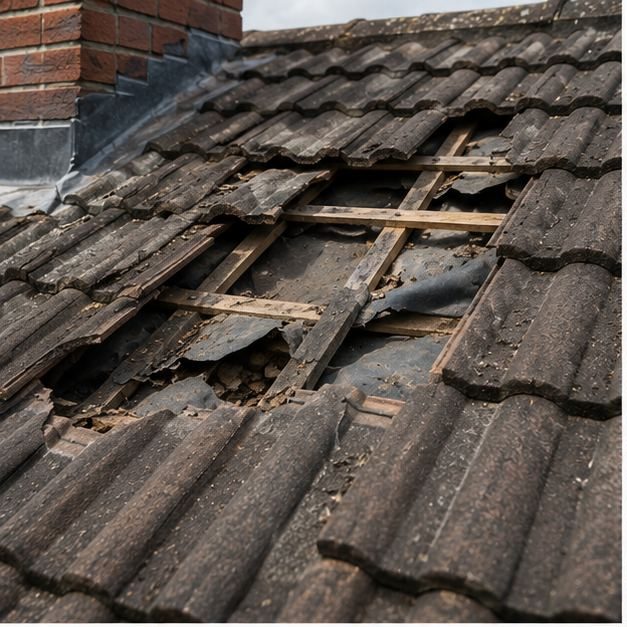
Stay on the ground first
Your first job is to keep everyone safe. Do not go onto the roof, and do not lean out of windows to get a better view. Fallen tiles, slates or chimney pieces can lie on paths and drives, so keep children and pets away from them until the area is clear.
If something is hanging loose over a doorway or path, keep people clear of the area below. Never pull at a dangling piece yourself. That is a job for someone with proper access equipment. Call us and describe what you can see from the ground, so we can plan access.
What you can check from outside and inside
Walk round the house at a safe distance and look up. Binoculars help. You are looking for gaps in the tile or slate pattern, a ridge that no longer runs straight, gutters hanging at an angle and debris in the garden that has clearly come from above.
Then go into the loft with a torch if the hatch is easy to reach. Look for daylight where there should be none, wet insulation, dark patches on timbers or drips. Do not step between the joists; stay at the hatch. Wet insulation can be heavy, so avoid pulling it about.
- Gaps or lifted sections in the tile pattern
- A ridge line that has shifted or cracked
- Gutters or fascias pulled away from the wall
- Daylight showing through the roof from the loft
- Damp insulation or fresh stains on the underside
Record it and limit the water
Take clear photographs of anything visible from the ground and anything you find in the loft, with a note of the time and conditions. These help in any conversation with a landlord or your own insurer later, and they help us understand what moved.
If water is coming in, put a bucket under the drip and move belongings out of the way. A temporary covering over a damaged slope is something we arrange safely, not something to attempt from a window. Switch off any light fittings that are visibly wet and keep electrics clear of drips.
What we check when we visit
A storm rarely harms only the spot you can see. We look at the whole slope and the one beside it, at ridge and hip bedding, at valleys and lead flashings, and at the verge edges where the wind gets underneath first. Terraces with a shared roofline need a look at both sides of the party wall.
Extensions and flat-topped bays in Horfield often show damage at the joint where they meet the main house, because that is where covering, flashing and wall all have to agree. We check those joints before we decide what the repair involves. The same goes for rear extensions that sit lower than the main roof.
Repair now or plan a larger job
Some storm damage is a simple matter of refixing a handful of tiles and re-bedding a ridge section. Other jobs show that older fixings or a tired covering were already close to failing and the wind has simply exposed it. We tell you which it is and what is urgent.
Where a sensible repair will hold, we say so and do it. Where the roof is failing more widely, we explain why patching would keep costing you, and talk through the alternative. Larger work may need planning or Building Regulations checks — we advise before work starts.
Frequently Asked Questions
Should I go up to look at the damage myself?
No. Wet slopes, loose coverings and a strong wind make a roof dangerous even for someone confident at height. Look from the ground, use binoculars, check the loft from the hatch, and then call us for a proper look with the right access in place.
Can a leak start after the storm has passed?
Yes. Water often travels along timbers and felt before it shows as a stain, so a ceiling mark can appear well after the wind has dropped. That is why we trace it back to the real source instead of treating only the mark you can see.
Is every missing tile an emergency?
Not always, but a gap lets water reach the felt and timbers below, and the next blow can take more with it. Photograph it, keep your distance, and have it looked at promptly. We will tell you what is urgent and what can wait.
Talk to our team about roof repairs in Horfield
Every roof is different — the fastest way to get an accurate answer is a quick chat with our team.