
On open post-war estates, wind does a lot of the damage. This guide explains why concrete tiles slip or crack, what the signs look like from the ground, and how a proper repair is carried out.
Many roofs in Lawrence Weston are covered in concrete tiles on post-war semis and short terraces, set out in open ground where wind arrives with little to slow it. A tile that slips or cracks is rarely a freak event. Usually a few specific things have been working on it for a long time.
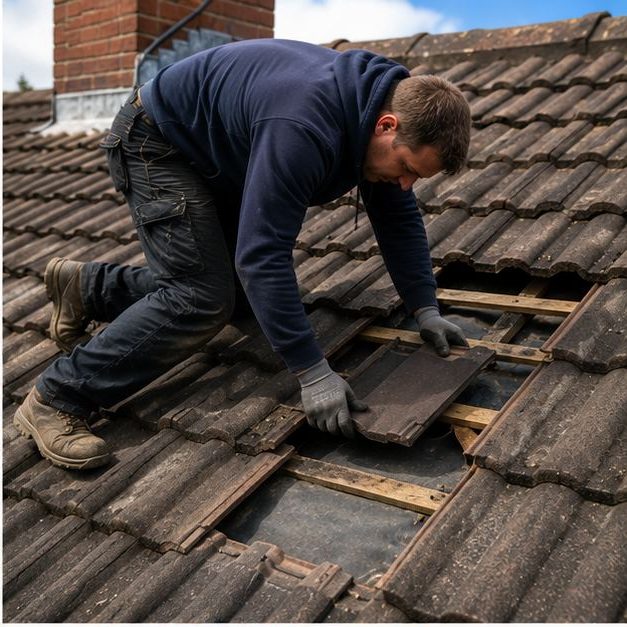
Wind is the first suspect
Wind coming in from the Severn side hits these estates head-on. It pushes air under the tile edges, lifts them and sets them rattling. Over many storms the tile shifts along its batten, and a tile that has moved even slightly is easier for the next gust to move further. Eaves, verges and ridges take the worst of it, since air is forced up and around those edges.
Fixings that have given up
Each tile is held by its hanging lugs and, on many roofs, by nails or clips at some courses. Nails corrode, battens dry out and soften, and the grip loosens. A roof that was sound when built can still have tiles sitting on very little. A tile that has dropped a few centimetres leaves a small gap, and gaps are where water begins to get in.
- Rusted nails or clips that no longer hold
- Battens softened by repeated damp
- Tiles shifted along their courses by wind
- Lugs chipped where tiles bear on the batten
Why concrete tiles crack
Concrete tiles are strong in compression but they can crack under a point load, such as a footfall from someone walking on the roof, or a branch or dislodged tile falling on them. Frost and long exposure also open fine cracks, which then widen. A hairline crack may look minor, yet water enters it and works its way through the underlay in time.
What we look at on a repair
We replace broken tiles, refix the loose ones and check the battens and underlay in the area. If a whole run has slipped, we look for the reason, such as rotten battens or damaged felt, instead of simply nudging tiles back into place. A match to the existing tile is found where possible, so the repair blends in with the rest of the roof.
What you can do from the ground
After a storm, look at the roofline from the street and the garden. Tiles out of line, gaps in the courses or pieces on the ground near the garage are all worth noting. Also check the loft for daylight or damp patches under the affected slope. Please do not go up to look. Call us and we will inspect with the right access.
Frequently Asked Questions
Can one slipped tile cause a leak?
Yes. A single displaced tile exposes the underlay to rain and sun, and water can track to a join or timber. It may take a few storms to show up inside, which is why small gaps are worth repairing promptly.
Should every cracked tile be replaced?
Where a crack goes right through, yes, since water will find it. We look at the condition of the surrounding tiles as well, and tell you if the roof as a whole is showing signs of wear rather than isolated damage.
Will storms keep causing the same damage?
Not necessarily. If the cause is a worn fixing pattern or soft battens, fixing that properly makes the roof more resistant to wind. We explain what we find so you can see whether the problem is local or general.
Talk to our team about roof repairs in Lawrence Weston
Every roof is different — the fastest way to get an accurate answer is a quick chat with our team.