
Replacement is a sequence of steps, and knowing the order helps you judge a quote. Here is what happens on a post-war semi from the first scaffold pole to the last gutter bracket.
Replacing fascias and soffits sounds simple, but on a house in Lawrence Weston the work has several stages, and each affects the next. From arranging safe access to checking the rafter ends and refitting the guttering, the job is a short chain of careful steps rather than one quick swap.
Access first
Boards sit at the eaves, which are well above head height. Safe access comes first, whether that is a scaffold or an access tower. On a semi, we agree where it will stand and how long it will be in place, and we make sure paths and neighbours' access are respected. Exposed estates also mean we keep an eye on the wind before taking boards off.
A fair quote also describes how waste will be taken away and how the garden and drive will be protected while boards are lifted. Those practical details say a lot about how tidy the job will be, and a roofer who has thought about them in advance usually works carefully on the parts you cannot see.
Removal and inspection
The gutters come down, then the old fascias, soffits and any bargeboards at the gable. Once the boards are off, the rafter ends and the eaves are visible, and we check them for damp, rot or insect damage before anything new goes on. Where a rafter end has gone soft, it is repaired or strengthened, since new boards on a weak base will not last.
- Gutters and downpipes taken down
- Old boards removed and eaves exposed
- Rafter ends checked and treated if needed
- Any debris or nests cleared from the roof edge
Fitting the new boards
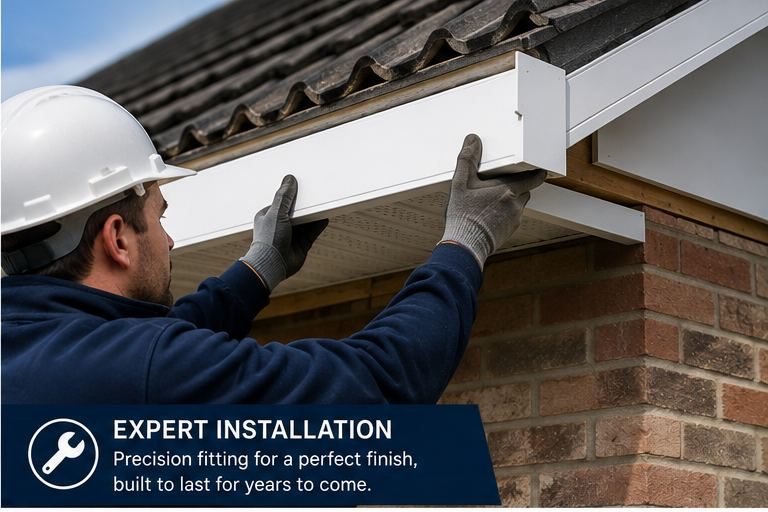
New UPVC fascias are fixed to the rafter ends, soffits are fitted underneath with vented boards or vent strips so the roof space can breathe, and bargeboards are matched at the gables. Joints are made tight and finished so there are no visible gaps. White is the usual finish, and darker and wood-effect options are available.
Gutters and finishing
Guttering is refitted once the boards are on. Sound gutters can go back up, but if they are cracked or sagging, new ones are the better choice. Falls are set so water runs to the downpipes, and joints are checked. The area is then cleared of offcuts, and the boards are wiped down. UPVC is very low maintenance, needing a clean rather than repainting.
What to ask before booking
Ask who handles access, how the eaves will be checked, whether ventilation will be fitted, and what is planned for the gutters. A clear written description should cover each of those. On houses where the existing soffit boards are old, we check what they are made of before disturbing them, and plan accordingly.
Frequently Asked Questions
Does the whole house need doing at once?
Not always. A rear or side elevation can be done separately if the front is sound, but the work is more efficient and neater in one go, especially with access in place. We advise on what makes sense for your house.
Will new soffits help with condensation in the loft?
Vented soffits or vent strips allow air to move through the roof space, which helps reduce damp. They do not solve every condensation problem, but they remove one common cause. We look at your loft when we visit.
What about the bargeboards at the gable?
They are replaced in the same way, so the edge looks consistent. We check the verge or mortar at the gable at the same time, since problems there are often found together with worn bargeboards.
Talk to our team about UPVC fascias and soffits in Lawrence Weston
Every roof is different — the fastest way to get an accurate answer is a quick chat with our team.