
Mortar verges age badly, with cracks, stains and gaps. A dry verge gives the gable a tidier line. This guide describes how it looks on a post-war semi and what affects the finish.
Gable ends are the most visible edge of a post-war semi or short terrace, seen from the road and the garden. A mortar verge ends up cracked, stained and patched, which spoils the line of the roof. A dry verge swaps it for a crisp, even edge, and the difference is noticeable.
The old mortar line
Many Lawrence Weston houses still have the mortar bed laid when they were built. It has weathered for decades, often with patches of repair in different shades. Moss collects in the cracks, and loose pieces drop onto the path below. Repointing makes it look better for a while, but the edge usually starts to break up again.
What the dry verge looks like
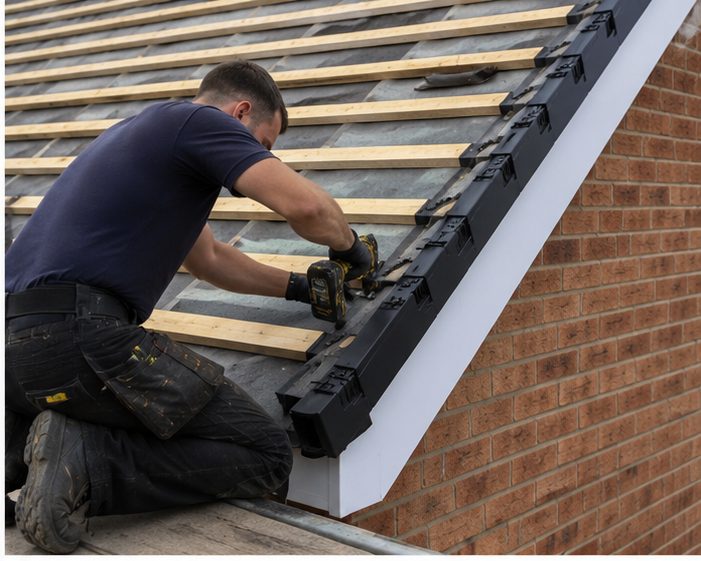
A dry verge is a run of purpose-made units that sit over the ends of the tiles along the gable, finished with matching end and cap pieces. The line is continuous and even, with a clean shadow gap where the edge overhangs the wall. Because there is no mortar, there is no joint to crack, stain or turn green, so the edge keeps its tidy appearance.
- A straight, even line along the gable
- No cracked or stained mortar bed
- Colour chosen to suit concrete tiles
- Finished end pieces at the eaves and ridge
Matching concrete tiles
Estate roofs here are largely concrete tile, and verge units come in colours that sit close to common concrete tile shades. They will not match an old, weathered roof exactly, but a good choice sits comfortably beside it. We show you the options and explain how the new edge will look against the existing tiles before anything is ordered.
Exposure matters on this side of Bristol
Open ground and Severn-side wind make the edge of the roof work hard. A fixed verge looks tidy and also resists lift better than a bed of old mortar. It is a rare case where a practical improvement and a better appearance go hand in hand. It is still not a cure for a roof failing elsewhere, and we say so if the tiles themselves need attention.
Checking before it is fitted
Compatibility depends on the tile profile, and we check that on site against the maker's guidance. We also look at the barge timbers and the wall edge to make sure they can take the fixings. A semi with a matching gable on the neighbouring house can look uneven for a while after one side is done, and we are open about that.
Colour and finish are worth settling before work starts. A short conversation about the tiles you already have, and how the new units will sit beside them, avoids any surprise or disappointment when the scaffold comes down and the edge is on show to the whole street.
Frequently Asked Questions
Will a dry verge look very different from the old mortar?
Yes, usually in a positive way. The edge is neat, level and consistent along its length, and the colour is chosen to sit well with the existing tiles. We explain exactly how it will finish before work begins.
Does the colour fade or stain like mortar does?
Moss and weathering can still collect on any surface, but there is no mortar to crack or discolour in patches. The units are very low maintenance, and a wipe from the ground level is all that most owners will think about.
Can only one gable be done?
Yes. Each gable is a separate edge, so you can do the worst one first. We would sooner talk through what is sensible for your house than suggest work you do not need straight away.
Talk to our team about dry verge systems in Lawrence Weston
Every roof is different — the fastest way to get an accurate answer is a quick chat with our team.