
Tiles rarely move without a reason. On exposed Victorian and Edwardian roofs near the Downs, wind, branches and ageing fixings are the usual suspects, and each leaves its own clues.
Walk along a street of villas near the Downs after a blustery night and you can often see a tile out of line or a fresh crack catching the light. The open ground to the side lets wind reach the roofs with little to slow it, and mature trees add their own share of knocks and debris.
Wind working on an exposed roof
Wind lifts tiles at the edges, ridge and corners first, where the pressure is greatest. Over time each gust loosens the fixings a little, and a tile that has been rocking for months finally slips. Roofs open to the Downs take this more than those tucked behind taller buildings.
Older roofs, where nails have corroded or the battens have weakened, give way sooner. That is why a run of slipped tiles often points to a tired fixing rather than plain bad luck, and why we check the tiles around a slip, not just the one that has moved.
Branches, debris and heavy wet leaves
Mature trees near a villa roof drop twigs and heavier branches in storms, and a falling bough can crack tiles outright. Leaves and moss that gather in valleys and behind chimneys hold water against the covering, and this can lift tiles or leave them cracked after frosts. We look for fresh breaks as well as slow wear.
If a branch has landed on the roof, tell us roughly when it happened and where it fell, because that tells us where to look for hidden cracks and displaced tiles that cannot be seen from the street. A photograph of the damage helps us plan.
Movement, age and frost
Clay and concrete tiles age. Water gets into the surface, freezes and flakes it away, so a tile that looked sound can crack under its own weight. Roof timbers also move slightly with the seasons, and tiles that were once snug can end up with a gap that lets them slide down.
- Nails that have rusted or snapped
- Tiles flaking along the face
- Battens that have rotted or moved
- Clips missing at exposed edges
What you can see without going up
From the ground, look along the roof for a tile that sits out of line, a dark gap, broken pieces in the gutter or on the path, and a ridge that looks uneven. Inside, the loft may show daylight or damp felt. Please do not climb up to look; note what you see and call us.
How we repair them
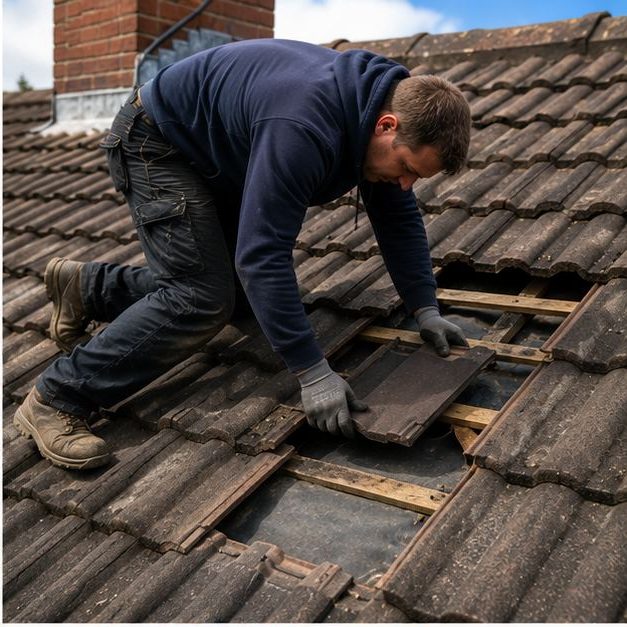
We replace cracked tiles, refix slipped ones and check the nearby fixings, because one failed tile often sits among others on the verge of going. If the same tile type is no longer made, we match it as closely as we can, and we are straightforward if a patch repair is no longer sensible.
If damage is widespread, we explain whether repair or re-roofing is the better judgement, and we show you what we have found so the reasoning is clear. Nothing is done until you know what is proposed and why. Where tiles are no longer made, we explain the closest match.
Frequently Asked Questions
Is a single slipped tile worth fixing?
Yes. A gap lets water reach the felt and battens, and wind can pull neighbouring tiles loose too. A small repair now is usually far less disruptive than dealing with damp timbers or a ceiling stain later.
Why do tiles slip after a storm and not before?
Fixings weaken gradually, so a roof can look fine until one hard gust finishes the job. The storm is the trigger, but the loosening has usually been going on for a while. Checking the nails is part of the visit.
Can I replace a tile myself?
We would strongly advise against it. Working on a roof is dangerous, and a tile put back incorrectly can fail again quickly. From the ground, note where the problem is, and call us for a proper look. Please leave it to us.
Talk to our team about roof repairs in The Downs
Every roof is different — the fastest way to get an accurate answer is a quick chat with our team.