
Finding where a flat roof leaks is a matter of following the water. Here is how we trace the entry point on bays, extensions and dormers around the Downs and what the repair involves.
Flat roofs on Victorian and Edwardian villas near the Downs sit on bay tops, rear extensions, porches and dormers. When one leaks, the stain on the ceiling is rarely where the water is getting in. Tracing it properly is the difference between a lasting fix and a repair that fails after the next storm.
Why the stain is not the source
Water enters a flat roof at one point, then runs along the deck, the felt or the insulation before it drops through the ceiling. By the time you see a mark it may be a metre or more from the real gap. Repairing the wrong spot achieves nothing.
That is why we resist a quick patch over the damp patch and trace the route first, working back from the stain through the ceiling, the timbers and the deck until the real entry point is clear. It saves repeat visits. Wind direction and rainfall at the time help us narrow it down.
What we look at first
We start with the usual suspects: splits and blisters in the covering, failed seams, upstands at the walls, edge trims and blocked outlets. Leaves from nearby trees often clog outlets and gutters, so water ponds and finds the weakest point. Wind can also lift edges and open joints.
- Ponding water and blocked outlets
- Cracks, splits and blisters in the covering
- Failed joints and seams between sheets
- Loose upstands and lifted edge trims
Tracing from inside
Inside, we check the ceiling, the timbers and the insulation, looking for the line the water follows. A damp trail along a joist or a patch of wet insulation points back toward the source. Pressing the deck from outside tells us whether boards beneath the covering are still firm.
Trees near a flat roof can hide the problem for a while, because leaf litter sits in the corners and blocks the outlets, so we also clear the surface and see how water is leaving the roof. That tells us how far the damp has travelled before we decide where to open up.
Repairing what we find
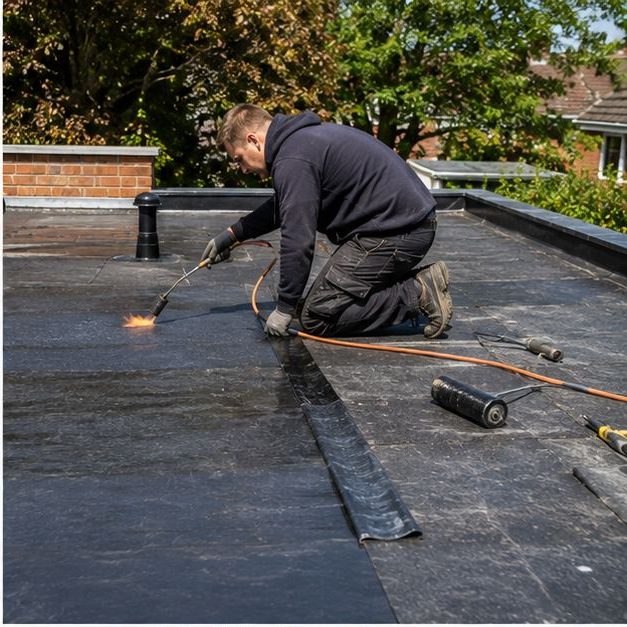
A localised fault, such as a split, a failed joint or a loose upstand, can be cut out and renewed with new covering that is properly bonded and lapped. Outlets are cleared and the surrounding area is checked for lingering damage. Wherever possible, we repair only what is needed.
If the deck has rotted, those boards must be replaced first, otherwise the new covering will fail over the same weak spot. We cut out the soft sections, fit sound boards and then renew the covering over them, so the repair is built on something solid.
When the whole roof is the problem
If the covering is cracked, blistered or worn across the whole surface, repairs keep reopening and a replacement is the honest answer. We explain this plainly, with the materials we would use, such as single-ply rubber, fibreglass or felt systems, and the falls and insulation that go with them.
Frequently Asked Questions
Can a leaking flat roof be repaired in wet weather?
A temporary measure may be possible, but a lasting repair needs a dry surface. We make the roof as safe as conditions allow, then complete the repair properly when the weather lets us. We then plan the work.
How do you find a leak that only appears sometimes?
We look at what the weather was doing when it leaked, since wind direction and heavy rain often point to a specific edge or junction. We then check the likely entry points one by one.
Why does my flat roof hold water?
Standing water usually means poor falls, a sagging deck or a blocked outlet. It speeds up wear on the covering. We check what is causing it and explain whether it can be put right with a repair. Clearing the cause is part of the job.
Talk to our team about flat roofing in The Downs
Every roof is different — the fastest way to get an accurate answer is a quick chat with our team.