
Ridge tiles and lead flashings are the two places an Eastville roof most often lets go. Here is what each repair involves, step by step, and what to ask before agreeing to it.
The ridge runs along the top of the roof and the lead flashings seal it where it meets walls and chimneys. Both are made of materials that move and age differently from the tiles around them. On Eastville's Victorian terraces and later infill houses, they are some of the most frequent repairs we are asked to do.
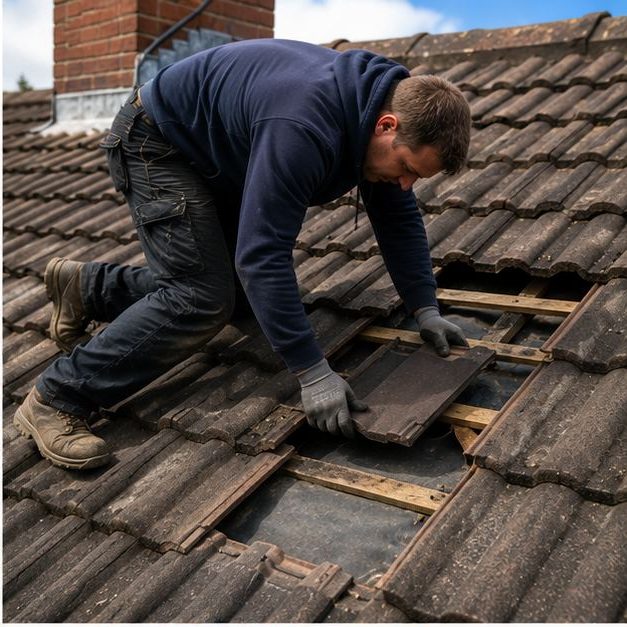
What goes wrong at the ridge
Ridge tiles are bedded in mortar along the top of the roof. The mortar cracks and loosens with weather, and the tiles then shift or lift in strong wind. Water gets in through the open joints, soaks the timber below and sometimes shows itself as a stain on a bedroom ceiling. A loose ridge is also a safety risk if pieces fall. Strong gusts are usually what finally move tiles whose bedding has already weakened.
How a ridge repair is done
We take off the loose or damaged ridge tiles, clear the old mortar, check the timber and felt underneath and re-bed the tiles on fresh mortar, or fix them with a dry-fixed ridge system where it suits the roof. Joints are pointed neatly and the line is set straight. Cracked tiles are replaced, not glued. Where the whole run is poor, we say so rather than patching a short length.
- Remove loose ridge tiles and old crumbling bedding
- Check the ridge board, felt and nearby tiles
- Re-bed or dry-fix tiles along a straight line
- Point and clear mortar so the joints shed water
Why flashings fail
Lead flashings seal the gap where the roof meets a chimney, a party wall or a taller wall. They can lift, split or pull out of the joint, and the mortar fillets that hold them often fall away. Wind and temperature changes work on them constantly. Where a rear extension joins the main house, a failed flashing is a common source of damp inside. Cutting out and replacing damaged lead is better than coating it over.
What a flashing repair involves
Sometimes we can dress the lead back and re-point it. Where it has split or is badly worn, we replace the section, cut a fresh chase in the mortar joint, fit new lead with proper laps and seal it in. The roof covering beside it is tidied so water runs onto the lead and away. Good detailing matters more than the amount of lead used. Neighbouring tiles are checked so the lead sits on a sound base.
Questions worth asking
Ask whether the whole ridge or just part is being done, what is being used to bed or fix the tiles and how the lead will be fixed into the wall. Ask what will be done if hidden damage appears. A written description of the work, with the photographs of what was found, helps you compare like with like. Photographs before and after show exactly what was done.
Frequently Asked Questions
Can a ridge be repaired without removing all of it?
Yes, if only part is loose and the rest is sound. We check the full length before deciding, because one failed section often means neighbouring bedding is close behind. We tell you which parts we recommend doing.
How do I know the lead flashing is the problem?
Stains near a chimney or party wall, damp patches on the ceiling edge and visible gaps at the wall junction all point that way. We confirm in the loft and from the roof, because water often travels before it shows.
Will the repair look different from the old ridge?
The finish should look neat and match the existing line. Colour of fresh mortar or dry-fix pieces differs slightly at first and weathers in. We explain what to expect before the work starts.
Talk to our team about roof repairs in Eastville
Every roof is different — the fastest way to get an accurate answer is a quick chat with our team.