
The middle of a flat roof rarely leaks first. The edges and the upstands against walls do, and rear extensions across Eastville show it again and again.
A flat roof covering can be in good shape across its main area and still let water in at the edges. The edge trims, the upstands where it meets a wall and the corners all depend on careful detailing, and they take the most movement. That is why so many leaks on rear extensions start there.
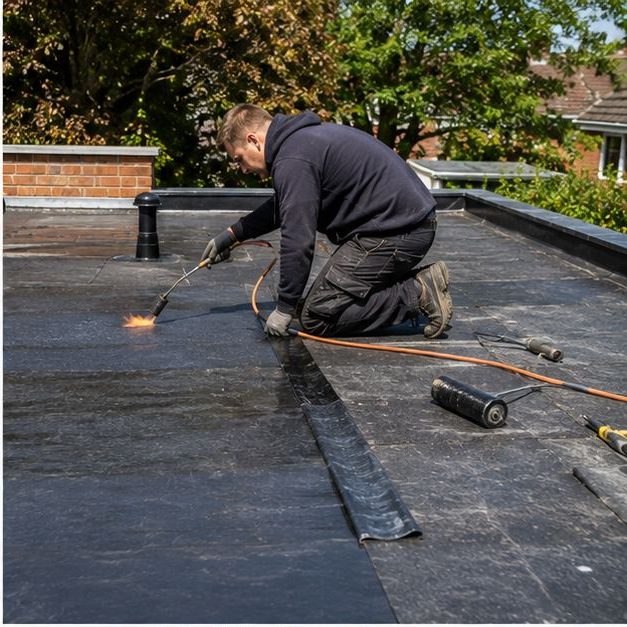
Where the covering meets a wall
The upstand is the part of the covering that turns up the wall. If it is too low, poorly fixed, or covered by a flashing that has failed, water runs behind it. Brickwork moves and mortar crumbles, and the sealed line opens up. A damp patch on an internal wall above an extension is a typical sign. Inside, the wall plaster just above the ceiling line is where it tends to appear first.
The roof edge and drip
At the outer edge, a trim or drip guides water into the gutter. If it has lifted, rusted, cracked or been fixed too loosely, water runs back under the covering. Gutters set too high or too low make the same problem worse. Edge failures often show as staining on the fascia or wall beneath. We also check that the drip lets water fall clear of the wall below.
- Edge trims lifting, bent or rusted
- Water tracking behind the covering at the drip
- Gutters set so that water splashes back
- Fascia boards soft where water has sat
Corners, joints and penetrations
Internal and external corners have to be shaped properly, because flat coverings do not like being folded sharply. Pipes, vents and rooflights need their own collars or upstands. These details are done by hand, and quality varies. A small split at a corner can let a surprising amount of water in. Soft or rounded corners are a sign that a patch has been made over a patch.
Movement and age
Extensions and the main house move at different rates, and the junction between them takes the strain. Over time, sealants harden and coverings stiffen. Frost and heat make it worse. Repeated movement opens joints that were sound when new, which is why these details need checking before the middle of the roof. Rear extensions on Eastville terraces join the old house at exactly this line.
Repair or replace
Where the main covering is sound, we can often renew the trims, re-form the upstand and rework the flashing without replacing everything. Where the covering is tired or widespread splits show, a new covering with proper edge details is the lasting answer. We tell you which applies, and describe each detail in writing. Photographs of each detail go with the written findings.
Frequently Asked Questions
Can I just seal the edge with a sealant?
A sealant can be a short-term stopgap, but it fails where movement is happening. A proper repair rebuilds the detail: trim, upstand and flashing as needed. We tell you honestly whether sealing is worth doing.
How can I tell if the leak is at the edge?
Leaks showing near the walls or the outer ceiling edge usually point there. Stains on the wall above or beneath the fascia help too. We confirm by inspecting the details, because water may travel before it shows.
Does the whole roof need replacing?
Not necessarily. If the main covering is sound, the edges and upstands may be repaired in isolation. If the covering is failing in several places, replacement tends to be more sensible. We examine the roof before advising.
Talk to our team about flat roofing in Eastville
Every roof is different — the fastest way to get an accurate answer is a quick chat with our team.