
Ridge tiles and lead flashings sit at the joints where roofs are most likely to let water in. Here is what repairing them actually involves, step by step.
Hengrove has large inter-war and post-war estates of semis and short terraces, and many of the roofs are hipped, so there are plenty of ridges, hips and chimney junctions. Those are the places where mortar cracks and lead lifts. Repairs at these points are usually modest, provided they are caught before water reaches the timbers.
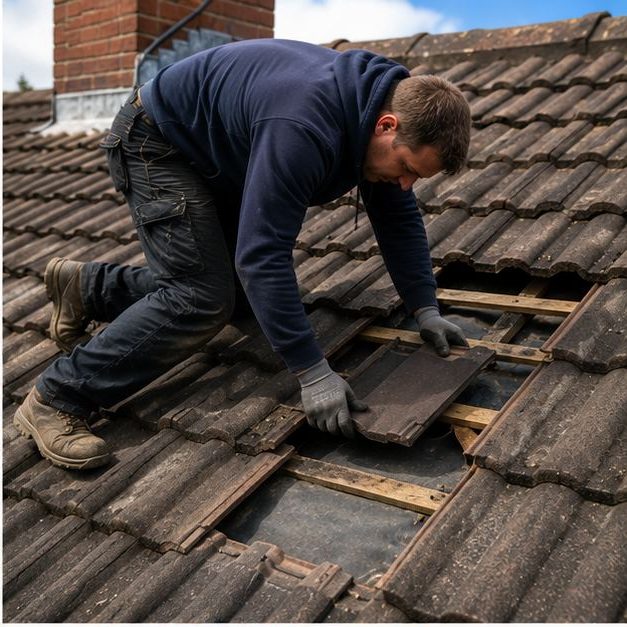
Why ridges and flashings fail
Ridge tiles are bedded in mortar along the top of the roof, and hipped roofs add sloping hip lines with their own tiles. Over time the bedding cracks and tiles shift. Lead flashings are dressed into brickwork at chimneys and walls, and they can lift, split or pull out as the building moves and weathers.
Garages and bungalows have their own ridges and hips as well. A lower roof is easier to see from the ground, but the causes and the repairs are the same, and the same care goes into getting the bedding and the lead right.
What we look at first
From the ground we look for ridge tiles out of line, gaps in the bedding, lead standing away from the stack and stains on the chimney breast. In the loft we check for daylight at the ridge, damp timbers and stained felt below the junctions. That tells us how far the problem has travelled.
- Ridge lines that dip, wave or show gaps
- Fragments of mortar in gutters or on the ground
- Lead lifting from brickwork or showing splits
- Damp marks on chimney breasts and ceilings below
Ridge and hip tile repairs
Where bedding has failed, we remove the loose tiles, clean back the old mortar, and re-bed the ridge and hips on fresh mortar, or fix them mechanically where that suits the system. Cracked tiles are replaced. Hip ends and the point where hips meet the ridge get particular care, because that junction is awkward to seal.
Done properly, the line looks straight and the joints stay tight through the winter. Ask us to show you the finished junctions in photographs, so you can see for yourself what has been done at the hips and along the ridge. That record is useful for you later.
Lead flashing repairs
Small splits and lifted edges can sometimes be repaired, but lead that is thin, worn or badly detailed is better renewed. New lead is dressed over and into the roof covering and chased into the brickwork, then sealed. Getting this right matters, since chimneys are a common route for water into the house.
- Old flashing stripped back to sound brickwork
- New lead dressed correctly over the covering
- Joints and laps arranged so water runs away
What to ask a roofer
Ask how the old bedding will be removed, whether the ridge will be re-bedded or fixed dry, and how the lead will be fitted and sealed. Ask for the work in writing and for photographs of the finished junctions. We explain all this plainly and tell you what is urgent and what can wait.
Frequently Asked Questions
Can ridge repairs be done without scaffolding?
Sometimes, depending on access and the height of the house. Where the work is at the edge or on a taller property, access equipment makes the work safer and better. We tell you what is needed before we start.
Is it worth repairing old lead or should it be replaced?
If the lead is sound and has only lifted, a repair can be enough. If it is thin, split in several places or poorly fitted, renewing it is usually the better route, and we explain why on site.
Will a ridge repair stop a leak in the loft?
If the ridge is the source, yes. Water can enter elsewhere and travel along timbers, though, so we check the loft before deciding, and tell you if something else is involved. We tell you what to expect before work begins.
Talk to our team about roof repairs in Hengrove
Every roof is different — the fastest way to get an accurate answer is a quick chat with our team.