
A dry verge replaces the mortar along a gable roof edge with fixed units. This explains the parts, the method and where it fits.
The verge is the edge of the roof where it ends at a gable. On the semis and short terraces of Hengrove's inter-war and post-war estates, those gable edges were finished in mortar, and plenty of it has cracked and dropped out. A dry verge does the same job a different way, with no wet mortar involved.
The basic idea
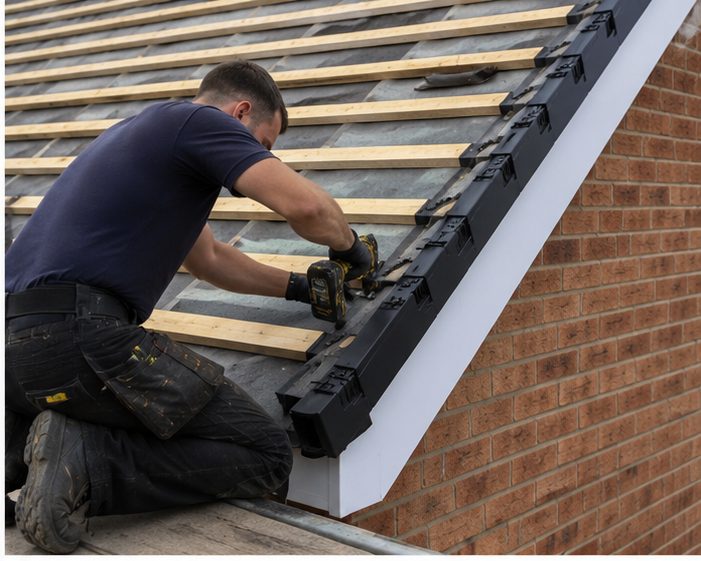
Instead of bedding the end tiles in mortar, a dry verge uses purpose-made units that run along the edge of the roof and hold the tile ends in place. They are fixed mechanically to the roof structure. There is nothing to crack or wash out, so the edge keeps its shape through frost and wind.
Because the units are factory made to a set profile, the finished edge is even and consistent along its length. That is hard to achieve by hand with wet mortar, especially in cold or damp weather when it will not set well. That makes it a tidy fix.
The parts of the system
A typical system has verge units that run along the gable, tile-end or cap pieces that finish the tiles neatly, and fixings that tie the units to the battens or rafters. Each is made to suit particular tile profiles. Pieces are cut or chosen to fit the roof, then fixed to the maker's guidance.
- Verge units running along the gable edge
- Cap or tile-end pieces matched to the profile
- Mechanical fixings into the roof structure
Why it behaves better than mortar
Fixed units resist wind lift at the edge, where gusts do the most damage. With no mortar there is nothing to fall on paths and drives, and the sealed edge keeps weather, birds and insects out of the roof space. It is a tidy finish that also needs very little attention afterwards.
Where it suits and where it does not
A dry verge suits new roofs, re-roofs and repairs where the mortar has failed. It is not a cure for a roof failing elsewhere, so if the tiles are slipping across the slope or the felt is worn out, that needs dealing with first. Compatibility depends on the tile profile, which we check on site.
Hipped roofs have fewer verges than gabled ones, but gable ends, side extensions and garages often have them. Those are the edges we most often see losing mortar, and the ones where a dry verge repair makes a visible difference. Each gable is judged separately.
- Roofs where the mortar has kept failing
- Re-roofs where the edge is rebuilt anyway
- Tile profiles that have a matching unit
What to expect on the day
We remove loose mortar and old end tiles, check the edge timbers, then fit the units and cap pieces and secure them. The work is mostly at the edge and can often be done without disturbing the main slope. Ask for the method in writing so you know what is being fitted and how it is secured.
Frequently Asked Questions
Does a dry verge need scaffolding?
Usually some form of safe access is needed for edge work at height. We arrange it and explain what will be used before the work begins, so there are no surprises on the day. Edge work is not something to attempt yourself.
Will it match my existing tiles?
Units are chosen to suit the tile profile and colour as closely as possible. Where an exact match is not available, we tell you what the nearest option looks like and what it means for the finish. We confirm the match before ordering.
Can a dry verge fix an old mortar problem permanently?
It removes the mortar that fails, so that weak point goes. It does not make a worn-out roof last indefinitely, though, so we also look at the tiles and timbers around the edge. We check the whole edge as part of the visit.
Talk to our team about dry verge systems in Hengrove
Every roof is different — the fastest way to get an accurate answer is a quick chat with our team.