
A small repair is sometimes enough, but many fascias are past it. Here is how we decide, and what we look at before suggesting either.
Plenty of Hengrove's inter-war and post-war semis and bungalows still have their original timber fascias, soffits and bargeboards, and many are showing their age. A short length of board can sometimes be saved. More often the sensible move is to renew the run. What matters is what is going on behind the visible face.
When a repair is enough
If rot is confined to a short section, the neighbouring boards are firm, and the rafter ends behind are sound, a repair can make sense. That might be cutting out the bad piece and fitting a matching length, or fixing a loose board. It works best on one small, clearly defined area.
Whichever way it goes, you should know why we recommend it. If a repair will hold, we will say so. If the boards are past saving, we will show you where the damage is and explain what would happen if the work were put off.
When replacement is the better answer
Rot rarely stays put. Boards that are soft in several places, joints that have opened, paint that is flaking all over, or gutters that have been leaking along the run all suggest the whole fascia has taken on water. Patching in those cases tends to leave you calling us again soon.
- Soft timber in more than one place
- Repeated gutter leaks along the run
- Open joints and peeling paint across the boards
- Rafter ends showing damp behind the board
What we check before deciding
We look at the fascia face, the underside, the soffit and the gutters. Behind the boards we check the rafter ends and the eaves, because that is where hidden rot and ventilation problems show up. On older homes we check what the existing soffit boards are made of before disturbing them.
What replacement involves
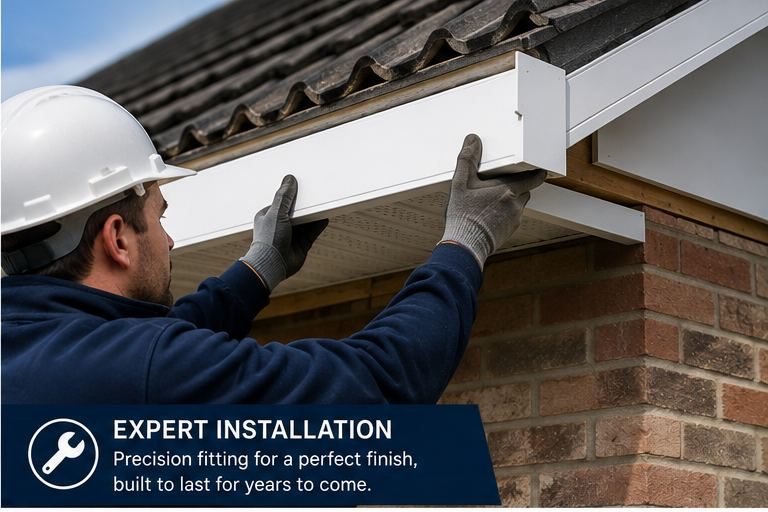
We remove the old boards and gutters, deal with any damaged rafter ends, fit new fascias and vented soffits or vent strips so the roof space can breathe, then refit or replace the gutters. Scaffold or other access is needed for safe work. Bungalows may be lower, but the work is the same.
UPVC is cleaned, not painted, and is very low maintenance. It comes in white, darker shades and wood-effect finishes, so a house keeps a smart look without a repainting routine, and the choice of colour is made with you before any boards are ordered.
- Old boards and gutters removed together
- Rafter ends and eaves inspected
- New boards with ventilation built in
- Gutters refitted or replaced after the boards
Asking the right questions
Ask whether the gutters will come off and be refitted, how the soffit will be ventilated, and what happens if rotten rafter ends are found. Request the description in writing. We say plainly if a repair is enough, and we say just as plainly if it is not.
Bungalows and garages usually need less access equipment, but the checks behind the boards are exactly the same. Rafter ends, eaves and ventilation get the same attention on a low roof as on a tall one. Ask for that to be confirmed in writing.
Frequently Asked Questions
Can I just paint rotten fascias?
Paint hides rot but does not cure it. Soft timber should be cut out or replaced. Painting sound timber afterwards helps protect it, but only after the damp problem has been sorted. Cutting the rot out and covering over it is not a fix.
Do I need to replace the soffits as well?
Usually it is sensible, because they are fixed against the fascia and share the same exposure. New vented soffits also help the roof space breathe, which keeps timbers drier. We can fit new ones in matching or fresh colours.
Will new fascias need regular painting?
UPVC does not. It needs occasional cleaning and is very low maintenance. The colour and finish stay the same without repainting, which is a key reason many homeowners choose it. It is worth asking about colour before work starts.
Talk to our team about UPVC fascias and soffits in Hengrove
Every roof is different — the fastest way to get an accurate answer is a quick chat with our team.