
An inspection is more than a look at the tiles. This is the order we work in on an exposed Bishopsworth semi, and what you should expect a roofer to explain afterwards.
When a roof leaks, the first job is to work out where the water gets in, which is rarely where it shows. On the higher, open ground around Bishopsworth, wind-driven rain finds weak points on semis and estate houses that a calm day would never reveal. A proper inspection follows a routine, so nothing is skipped.
Talking it through first
We begin by asking you questions. When did you first notice it, does it follow wind or heavy rain, and has anything been done before? On exposed ground, a leak that only appears when rain blows from one direction points us straight toward one side of the roof. Your answers shape where we look and save time on the day. It also tells us whether we are dealing with one fault or several.
Inside the roof space
From the loft we look for daylight, dark tracking on felt and timber, wet insulation and rusted fixings. We follow the marks uphill to find where water first entered. Inter-war and post-war houses often have older felt that has dried and cracked, so we check how it has aged as well as where it is wet. Fixings that have rusted through tell us how long water has been present.
- Daylight showing through the covering.
- Staining on rafters and the felt.
- Damp or flattened insulation under the stain.
- Water tracks pointing to a source.
The tiles, hips and ridge
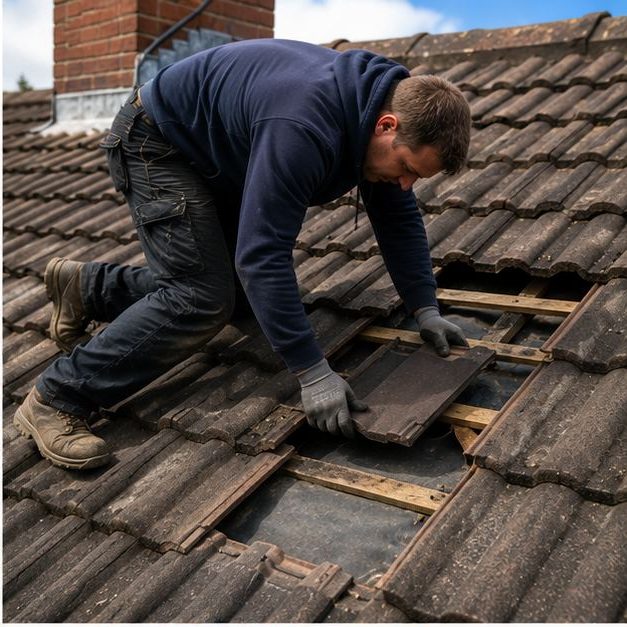
Outside, with proper access, we look at the field of tiles for slips, cracks and missing pieces. Hipped roofs, common on these semis, have hip tiles and ridge bedding that crack and loosen in wind, so we study every run. We also check the verge edges, where gusts get underneath, and how the tiles sit along the eaves. Nothing is signed off until every run has been looked at.
Flashings, chimneys and gutters
Junctions are where roofs fail. We check the lead or flashing around chimneys, the line where a garage roof meets the house wall, and any porch or bay joins. We look at gutters and downpipes too, since overflowing water can soak the eaves and look like a roof leak from inside. Each is checked, not assumed.
- Flashing around chimneys, walls and abutments.
- Gutter joints, brackets and falls.
- Eaves where overflowing gutters soak the boards.
- Junctions with garage and porch roofs.
What you should be told
After the inspection, you should get a plain explanation: what we found, where, what caused it, what is urgent and what can wait. Photos help. Ask whether the repair deals with the cause, and whether other areas are near the end of their life. You should leave understanding the roof better than when we arrived. That clarity is the point of an inspection.
Frequently Asked Questions
How long does an inspection take?
It depends on the size and complexity of the roof and how easy it is to reach. A straightforward semi is quicker than one with a garage, porch and chimney. We do not rush it, because speed is how things get missed.
Will you tell me if nothing is wrong?
Yes. Sometimes the leak turns out to be a gutter, condensation or a plumbing fault rather than the roof. We say so plainly and point you in the right direction rather than inventing roof work.
Can I be present during the inspection?
Of course. You can come into the loft with us and see what we see, and we will show you photos of anything outside. Please stay off the roof itself; we use proper access for that.
Talk to our team about roof repairs in Bishopsworth
Every roof is different — the fastest way to get an accurate answer is a quick chat with our team.