
A roof that stays dry in a shower but drips in a downpour is telling you something specific. Here is what heavy rain exposes on Lawrence Hill terraces and how the true entry point is found.
Light rain runs off a roof in an orderly way. Heavy rain overwhelms small weaknesses: a lifted tile edge, a thin flashing joint, a gutter that cannot clear the flow. On the Victorian terraces and later blocks in Lawrence Hill, where roofs meet party walls, chimneys and rear additions, there are plenty of junctions for water to try.
Why only the heavy rain gets in
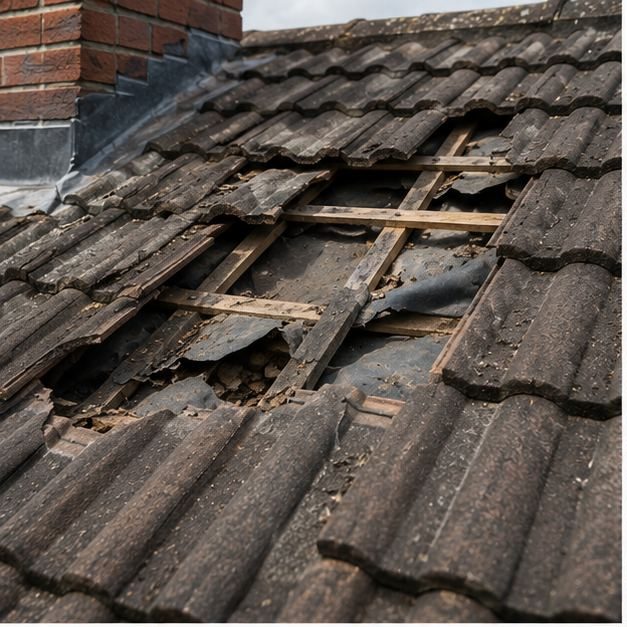
Water needs a gap and a reason to use it. A small opening beside a tile may stay dry through ordinary rain because the water simply runs past. In a downpour the volume is higher, the flow is faster and wind pushes it sideways and uphill, so the same gap suddenly lets water through. That is why a leak can appear after a storm and then vanish for weeks. It has not healed. The conditions that expose it have just not come round again.
Where it usually starts on a terrace
Terraced rows have more joins than detached houses. The valley where two roof slopes meet, the lead tucked against a chimney or party wall, and the ridge line all take the hardest water. Any one of them can be worn without looking dramatic from the street. Gutters matter too. If a shared run overflows, water backs up under the lowest tiles and soaks the timbers beneath.
- Cracked or slipped tiles near the eaves
- Worn lead where the roof meets a party wall or chimney
- Valley linings that have split or silted up
- Ridge mortar that has cracked and let in driven rain
Rear extensions and flat sections
Lawrence Hill has many rear extensions, and the joint between the old pitched roof and a newer flat section is a frequent culprit. The upstand, the lead and the edge detail all have to work together, and a small failure there often looks like a pitched roof leak from inside. We look at both roofs in the same visit, because water entering at the join can travel a long way before it shows.
Why the stain is not the source
Rain enters, runs along a rafter or down the felt, and appears wherever it finally finds a way out. A ceiling mark can be a metre or more from the real opening. Treating the stain by repainting or sealing the nearest tile rarely stops the problem. Tracing means working back from the damp: following the timbers, checking the felt, and then reading the roof covering above that line.
What you can check from indoors
Start with the loft if you can reach it safely from a fixed stair or hatch. Look for daylight through the covering, dark or wet timbers, and felt that is stained or sagging. Take a photo, and note whether the damp is worse after wind or after plain rain. Please do not go onto the roof or lean a ladder against it to look. Call us and we will carry out a proper inspection.
Frequently Asked Questions
Can a leak cause damage even if I only see it in heavy rain?
Yes. Water that gets in during storms soaks insulation, timbers and plasterboard even when the surface looks dry afterwards. Slow, repeated wetting is how rot and mould start, so it is worth having the cause looked at before the next wet spell.
Will you need to strip the whole roof to find the leak?
Almost never. We trace the water from the stain back through the loft, then inspect the likely junctions and covering above it. Most leaks come from one or two specific points, and we explain what we find before any repair starts.
Is a temporary patch enough?
Sometimes a small repair is all the roof needs. If the covering is tired across a wider area, a patch only buys a little time. We tell you honestly which situation you are in, so you can decide with the facts.
Talk to our team about roof repairs in Lawrence Hill
Every roof is different — the fastest way to get an accurate answer is a quick chat with our team.