
Three parts meet at the edge of a roof and people often mix them up. This guide separates fascia, soffit and gutter, and shows how to spot trouble on a terrace from the pavement.
Stand across the road from a Victorian terrace and look at the eaves. There is a board, a strip underneath it and a channel for the rain. Each does a different job, and a problem with one usually shows up in the others. Knowing which is which makes it much easier to describe what you can see, and to understand a quote when one arrives.
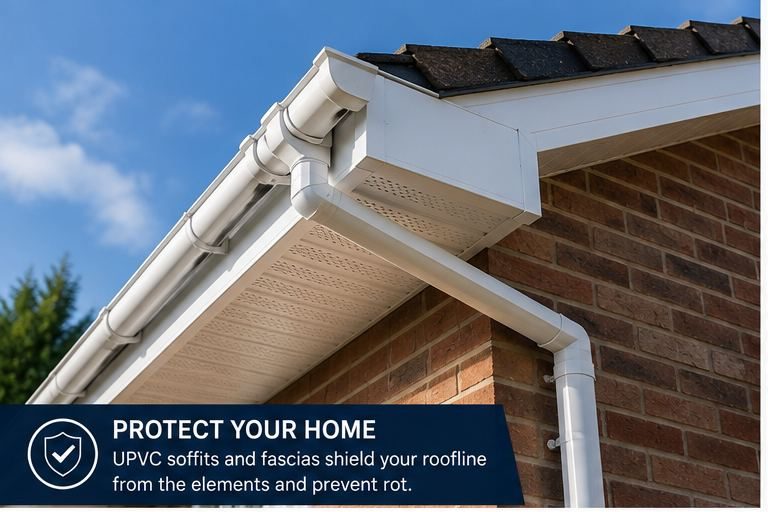
The fascia
The fascia is the board fixed across the ends of the rafters, facing outwards. It carries the gutter and gives the eaves a finished edge. Because the gutter hangs from it, any weight of water or a slipped bracket puts strain on the board. On older terraces the fascia is often timber, and timber that has sat damp for a long time will soften and split.
The soffit
The soffit is the board that closes the underside of the eaves, running from the wall out to the back of the fascia. It keeps weather, birds and insects out of the roof space, and it is where ventilation can be built in, either as vented boards or as vent strips. From street level it looks like a flat strip beneath the overhang. Staining, sagging or holes in it mean something above is not right.
The guttering
Gutters collect the water from the roof surface and carry it to the downpipes. They are fixed to the fascia or to the rafter ends, and they only work if they are level, clear and joined without drips. A gutter that overflows soaks the fascia and the wall below it. On a long terrace run, a blockage at one end can send water over the whole length.
- Fascia: carries the gutter, covers the rafter ends
- Soffit: closes the underside, lets the roof breathe
- Gutter: gathers rain and delivers it to the downpipe
- Bargeboard: the matching board at a gable edge
How a fault in one affects the others
A leaking gutter joint wets the fascia behind it. A rotten fascia can no longer hold the gutter true, so it sags and holds water. A damaged soffit lets damp air into the roof space. The three are one system, so we look at all of them at the same time. That is also why a repair to a single board sometimes needs the gutter taken down first.
What you can see from the ground
Look for peeling or flaking paint, dark staining, bowed boards, gaps where the soffit meets the wall, plants growing from the gutter and drips from joints. Birds going in and out under the eaves are a sign that the soffit has been breached. Do not climb up to test them. Tell us what you have noticed and we will inspect from proper access.
Frequently Asked Questions
Do fascias and soffits need to be replaced together?
Not always, but they often are, because they are fixed together and the same weather affects both. We look at each board, and if only one is sound enough to stay, we say so rather than replace everything for the sake of it.
What are soffit vents for?
They allow air to move through the roof space, which helps keep timbers and insulation dry and reduces condensation. When boards are renewed, we fit vented soffits or vent strips so that airflow is not lost.
Is guttering part of the fascia job?
They are separate parts, but on a replacement the gutters normally come down so the fascia can be changed. We refit sound ones or fit new, depending on their condition, and we agree that with you before we begin, so the gutter line matches the finished boards.
Talk to our team about UPVC fascias and soffits in Lawrence Hill
Every roof is different — the fastest way to get an accurate answer is a quick chat with our team.