
Many homes in Lawrence Hill have a flat roof over a rear extension, and the repair-or-replace question comes down to the deck underneath. This explains how we decide and what you can expect to hear.
Dense terraced streets mean a lot of rear extensions, and a lot of extensions mean a lot of flat roofs. When one starts to leak, the sensible question is not how to stop the drip today but whether the roof underneath is still sound enough to repair. That is a judgement made from evidence, not from guesswork.
What decides it
Three things matter most: the state of the covering, the condition of the deck beneath it, and how widespread the faults are. A single split or a failed joint on an otherwise even surface is a repair. Faults spread across the whole roof usually are not. We also ask how often it has been patched before. Layers of old patches suggest the roof has been struggling for some time.
Signs a repair will do
If water is entering at one identifiable point, such as a cracked seam, a lifted edge or a blocked outlet, then fixing that point and restoring the surface around it can bring the roof back to a good working condition. The deck needs to be firm underfoot from inside the room and dry when we open it up. Repair also suits a roof that is otherwise flat, free of deep ponding and not breaking up.
- One clear leak point with sound material around it
- Deck firm and dry beneath the covering
- Surface still flexible rather than crazed or brittle
- Outlets and edges in reasonable order
Signs replacement is the better route
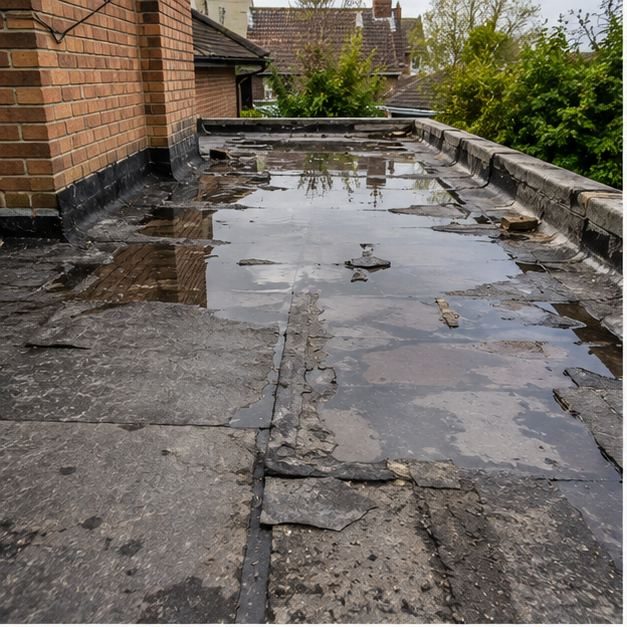
A soft or dark ceiling, a deck that has gone spongy, blisters and splits across the surface, or water standing in several places all point to a roof that has had its time. Patching these only moves the leak a short distance along. Where the boards or insulation have soaked through, the honest answer is to strip back and renew, rather than lay new covering over a rotten base.
What we check on site
We look at the surface, the upstands against the house wall, the edge trims and the outlets, and we check from inside for damp, staining and sagging. If we need to lift a small section to see the deck, we say so and show you what is under it. Falls matter as well. A roof that holds water will fail again sooner, whatever has been laid on top, so we look at whether the slope towards the outlet can be corrected.
Choosing a covering if it is replaced
Single-ply rubber, fibreglass and felt systems all have their place. The choice depends on the shape of the roof, how many penetrations and upstands it has, and how it will be reached for maintenance. We talk through the options and explain why we would pick one for your roof. Insulation and ventilation are decided at the same time, since the roof is open and it is the best moment to do it properly.
Frequently Asked Questions
Can I just paint a coating over a leaking flat roof?
A coating can help on a sound, dry surface that is only showing its age. It will not cure a rotten deck or a failed joint. We check what is underneath first, and only suggest a coating where it will genuinely hold.
How will I know whether the deck is rotten?
From inside, look for soft, dark or sagging ceiling areas below the roof. From outside, we test the surface and sometimes open a small section to see the boards. We show you what we find, so you can see the reasoning.
Does a replacement need the whole roof stripped?
Usually the covering is removed, and the deck is kept where it is sound and replaced where it is not. New insulation and a new surface follow. Work on a small extension roof is often straightforward, and we explain the sequence beforehand.
Talk to our team about flat roofing in Lawrence Hill
Every roof is different — the fastest way to get an accurate answer is a quick chat with our team.