
Most roof trouble comes from a short list of faults. Here is what we see most often on the mix of older and newer homes in Henbury.
Henbury is made up of older stone houses and cottages around a village-style core, with inter-war and post-war estates surrounding them. Roofs of different ages fail in different ways, but the same few problems turn up again and again. Knowing them helps you spot trouble early, from the ground.
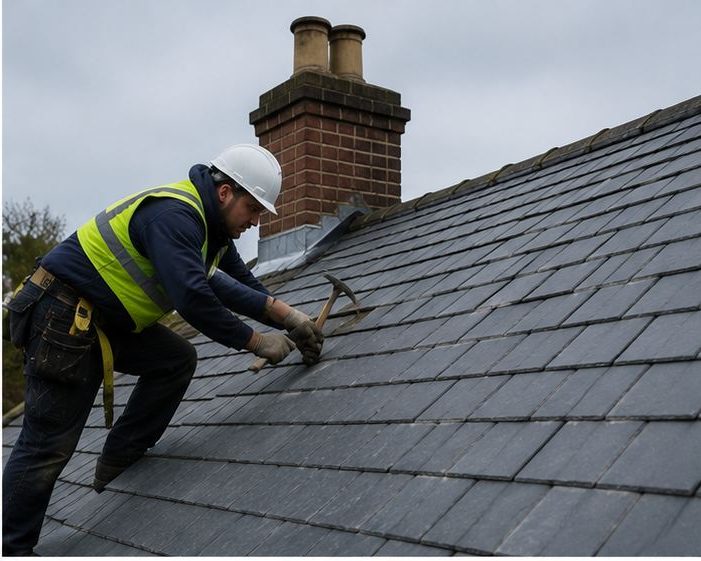
Slipped, cracked and missing tiles
Wind, age and frost loosen coverings, and individual tiles slip or crack. Each gap lets water reach the felt. You may spot pieces in the garden or a visible dip in the line of the roof. A few replacements put things right, provided the battens beneath are still sound. On cottages and older houses, hand-fitted coverings can loosen in ways that look different from estate roofs, so a repair is matched to what is already there.
Ridge, hip and verge mortar
Mortar that bedded the ridge, hips or verges dries, cracks and falls away over time. Pieces landing on paths and drives are an early sign. Re-bedding the ridge or fitting a dry verge system removes the weak point, as long as the covering below is still in decent condition. Where the tiles are sound, a new edge finish can be done without touching the rest of the slope.
- Cracked mortar on ridge lines
- Ridge tiles sitting out of line
- Mortar fragments on paths or drives
Lead flashings and chimneys
Lead around chimneys, valleys and abutments lifts, splits or pulls away. Water then runs behind the stack or down inside the wall. Stains on chimney breasts are the usual giveaway. Repair or renewal of the flashing is usually far smaller than the damp damage it prevents. Chimney stacks also deserve a look from the ground for cracked pointing, which can let water in alongside the flashing.
Gutters, fascias and flat roofs
Blocked gutters overflow onto fascias and walls, and timber boards rot where water sits. Flat roofs on extensions, garages and porches develop ponding, splits and failed joints. All of these are visible from the ground in some form, which makes them good candidates for an early call to us. Fascia and soffit boards that are failing can also let birds and insects into the eaves, so they matter even when no leak shows.
- Gutters spilling over in rain
- Peeling or soft fascia boards
- Puddles lingering on flat roofs
Why the loft tells you most
Many problems show inside before they show outside. Daylight through the roof, damp timbers and stained felt all point to a fault, and condensation causes plenty of what looks like a leak. A loft check, plus a ground view, usually lets us say what needs urgent attention and what can wait. If you can, note when stains appear and send us photographs, because that history speeds up the diagnosis considerably.
Frequently Asked Questions
Which problem is the most urgent?
Anything letting water in, such as a missing tile, a lifted flashing or a failed flat roof joint. Cosmetic ageing can usually wait, and we will say which is which after looking. We prioritise by risk.
Are leaks always at the stain?
No. Water travels along timbers and felt before showing, so the stain may sit well away from the true entry point. That is why we trace the source properly rather than patching where it appears.
Do older and newer homes have different problems?
Often. Older stone houses and cottages tend to have their own quirks, while estate homes more commonly show wear in ridges, gutters and fascias. We look at each roof individually rather than assuming.
Talk to our team about general roofing services in Henbury
Every roof is different — the fastest way to get an accurate answer is a quick chat with our team.