
Central Bristol roofs share a handful of recurring faults. This guide lists the ones we meet most often in Old Market and explains what causes them.
A mix of older terraces, converted commercial buildings and newer flats means roofs in Old Market fail in a fairly predictable set of ways. Most problems start small and are easy to miss. Knowing what to look for from the ground helps you catch them before they reach the ceiling.
Flat roofs that do not drain
Many buildings here have flat sections on extensions, outbuildings and between pitched roofs. Standing water, splits at joints and blocked outlets are the usual complaints. Left too long, they let moisture reach the deck, which can then rot. Repair is often possible, but widespread damage points to a replacement.
On small flat roofs, the cause is often as simple as a blocked outlet or a failed joint at the wall. Those are fixable, and finding them early keeps the repair modest and the deck underneath dry and sound, which matters more than the surface.
Parapet walls and hidden gutters
Parapets look smart but hide gutters that quietly clog with debris. Overflow runs into the wall and shows up inside as damp. The lead or lining at the base of a parapet also wears. Problems here are easy to miss and slow to show, so a proper inspection is worth having.
Slipped tiles and worn ridges
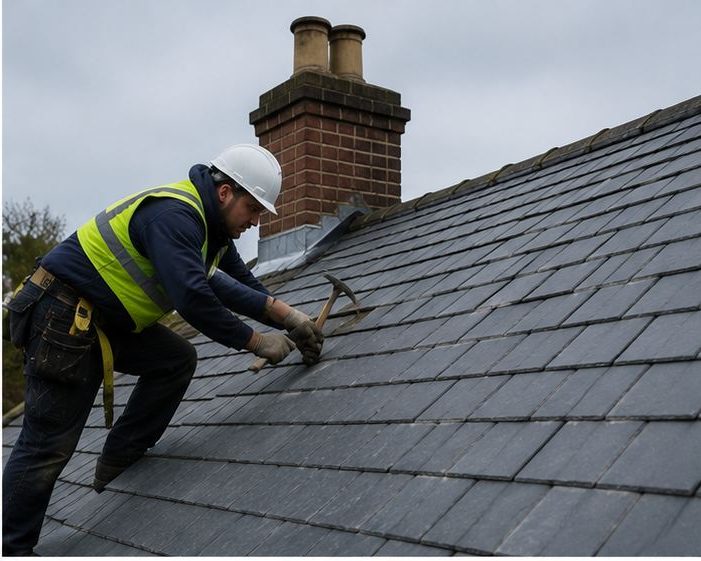
On pitched roofs, tiles and slates loosen with age and weather. Ridge and hip bedding cracks and falls away, leaving the top of the roof exposed. A missing piece may look minor, but it lets water onto the felt beneath, so we replace and re-bed promptly, then check what the water has reached.
Moss and debris also collect around ridges and valleys, which holds water against the covering. Clearing them properly is a job for someone with safe access, not something to attempt from a ladder, and we check the covering as we do it.
Lead flashings and chimneys
Where roofs meet walls and chimneys, lead flashings and valleys take the movement and the weather. They split, lift or pull away. Old terraces have plenty of these junctions, and many leaks that look like a roof fault actually start there. Repairs are usually targeted and neat.
- Cracks in the lead or sealant at junctions.
- Chimney stacks showing damp on the walls below.
- Stains on ceilings near chimney breasts.
- Gaps where the roof meets a party wall.
Gutters, fascias and eaves
Blocked or sagging gutters and rotten fascias send water where it should not go. They are among the most common faults and the easiest to spot from the street. Fixing the eaves properly, with ventilation, protects the rafter ends and keeps the roof space dry, which prolongs the life of everything above it.
Frequently Asked Questions
Which problem is most urgent?
Active leaks, loose coverings that could fall and anything letting water into the structure come first. Cosmetic issues and slow wear can wait. We sort the list so you can see what matters now.
Can I spot these problems myself?
Some of them, from the ground. Look for missing tiles, sagging gutters, stains inside and damp patches on walls. Do not climb up or use ladders to check. If anything looks wrong, call us for a proper look.
Do all leaks mean a new roof?
No. Many leaks come from a single defect such as a split flashing or a slipped tile. We trace the true source and recommend replacement only when the roof as a whole has reached the end of its useful life.
Talk to our team about general roofing services in Old Market
Every roof is different — the fastest way to get an accurate answer is a quick chat with our team.