
Post-war estates share a few roof types, but the details differ house to house. This guide covers the main coverings for semis and garages and what exposure to wind means for the choice.
Houses in Lawrence Weston were built mostly as semis and short terraces, on open ground with a lot of wind. Most carry concrete tile roofs, with flat or low-pitched garages and porches alongside. The right roofing for a property depends on which part you are talking about, and on how exposed it is.
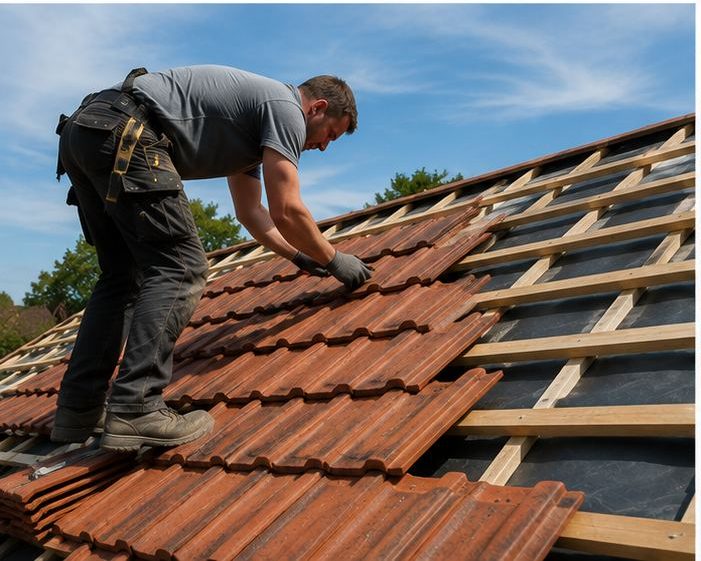
The main pitched roof
For most homes here, a concrete tile roof on timber battens is the norm, and replacing like with like is often the sensible route. Tiles are heavy and strong, and fit the roof structure the houses were designed for. If the covering has reached the end of its useful condition, we talk through options for a full re-roof, including the underlay, battens and edges.
If your house has been altered since it was first built, such as a rear extension or a loft room, tell us. Those changes alter the roof shape and the loading it carries, and they affect what covering and details will suit best, and what can be reused or kept.
Ridges, hips and edges
Exposed sites put pressure on the details. Ridge and hip tiles, verges and eaves are where wind attacks first, so fixings and edge details deserve particular care. Dry ridge and dry verge systems can reduce reliance on mortar. We check these details on every roof, because a good covering with a worn edge still fails.
- Ridge and hip tiles fixed securely
- Verges with mortar or dry verge units
- Eaves detail and underlay checked
- Lead around chimneys and walls in order
Garages, porches and flat sections
Garages and porches usually have flat or shallow roofs. Single-ply rubber, fibreglass and felt systems all suit different shapes. Falls, edge trims and the joint with the house wall matter as much as the covering you choose. We look at the condition of the deck first, then recommend what suits.
Where a garage shares a wall with the house, the joint between the two roofs gets particular attention, because it is a frequent place for water to find its way in, particularly in wind-driven rain from the open side. We check the flashing, the edge and the gutter there together.
Fascias, soffits and guttering
The roof edge works with the covering. Worn boards and gutters let water into the walls and eaves, so we include them when looking at the roof as a whole. UPVC boards are very low maintenance and suit most houses. Ventilation at the soffit helps the roof space breathe.
Deciding what you need
Think about how long you plan to stay, what else you may do to the house, such as a loft room or a rear extension, and how much upkeep you want. We tell you what is urgent, what can wait and what is a matter of preference. Planning or Building Regulations checks may apply in some cases, and we advise before work starts.
Frequently Asked Questions
Do concrete tiles suit exposed sites?
Yes, they are heavy and resist wind well when properly fixed. What matters is how they are held down and how the edges are finished. We check the fixings, battens and edge details whenever we look at a roof.
Can the garage be done in the same visit?
Often, though the roofs are different systems with different needs. Doing both together can save on access and disruption. We tell you which parts need attention now and which can wait. That keeps the plan simple.
Is a full re-roof always the answer?
No. Many roofs need repairs, ridge work or a new edge, not a new covering. We look at the whole roof and explain its condition honestly, so the work you agree to is the work the roof actually needs, and nothing is added for the sake of it.
Talk to our team about general roofing services in Lawrence Weston
Every roof is different — the fastest way to get an accurate answer is a quick chat with our team.