
Timber boards give good service for a long time, then ask for more upkeep than they are worth. These are the signs it is time to change.
Large villas and inter-war semis in Westbury-on-Trym often carry timber fascias and soffits that have been repainted many times. Exposed slopes and mature trees keep them damp for long stretches. Spotting when the wood has had its day, before it harms the roof edge, saves trouble.
The condition of the paint tells a story
Paint that flakes within a season or two of redecorating suggests moisture is getting in from behind or underneath. Dark patches, blistering and open joints at corners point the same way. When repainting becomes a regular chore, and the wood still looks tired, the board is probably past saving.
On a large villa the run of boards can be long, with corners, returns and gables to cover, so rot in one place can hide a wider problem. We follow the whole eaves line, not only the section that looks worst.
Feel and shape
Rot softens timber, so a board that gives under a screwdriver, crumbles at the edges or has started to bow is finished. Soffits can sag or show stains where water has dripped through. From the ground you may only see the surface, so we always look closely when we come to assess.
- Soft or crumbling edges on fascia boards
- Soffits sagging or stained from above
- Joints opening between lengths of board
- Paint peeling back to dark, damp timber
Gutters and rafter ends
Gutters are fixed to the fascia, so a weak board often shows up as sagging or leaking gutters. Overflow then soaks the wood further. Behind the boards, the ends of the rafters can take on damp too. If that spreads, repair becomes bigger, so acting earlier tends to keep the job simple.
Trees, leaves and exposure
Mature trees shed leaves into gutters and keep eaves shaded and damp, while exposed roofs take wind-driven rain onto the boards. Those conditions are hard on timber. UPVC does not rot and only needs washing, so it copes with that kind of setting very well and stays very low maintenance.
Making the change
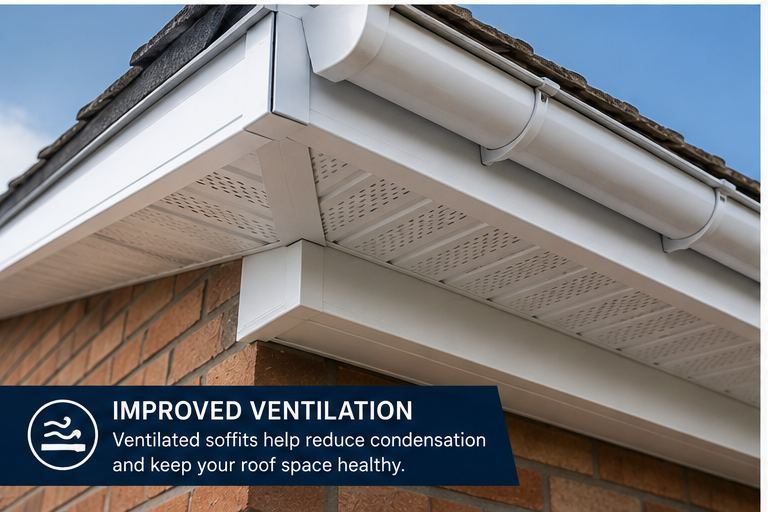
Replacement means removing old boards and gutters, checking the rafter ends and eaves, fitting new boards with vented soffits or vent strips, and refitting or replacing gutters. Finishes include white, darker colours and wood-effect. On older homes we check the existing soffit material first. It may need planning or Building Regulations checks, and we advise before work starts.
The finish is a choice as much as a practical decision. White is the usual choice, while darker and wood-effect finishes can suit stone and brick houses well. We can discuss what sits best with your roof and windows before ordering anything.
Frequently Asked Questions
Can one rotten section be replaced on its own?
Sometimes, if the rest is sound. But boards of different ages and materials look uneven, and the rest often follows soon. We tell you honestly whether a section repair is sensible or whether doing the full run makes more sense.
Does UPVC look right on a period house?
It can, particularly in a wood-effect or darker finish, and a neat profile helps. We discuss the house and its style on site and tell you plainly how the finished edge will look before you decide.
What about the gutters?
They come off during the work. If they are sound they can be refitted, but if they are worn or leaking, replacing them at the same time avoids setting up access again later.
Talk to our team about UPVC fascias and soffits in Westbury-on-Trym
Every roof is different — the fastest way to get an accurate answer is a quick chat with our team.