
A fascia looks like trim, but it carries the gutter and protects the rafter ends. When it fails, the trouble rarely stays at the board. Here is what can follow and what we check.
Walk along the older streets of Shirehampton and you will see fascia boards in every condition, from crisp to sagging. They are easy to ignore because they sit at the edge of the roof, but they do real work. A damaged board can let in weather, creatures and damp, and the consequences reach further than the board itself.
What the fascia actually does
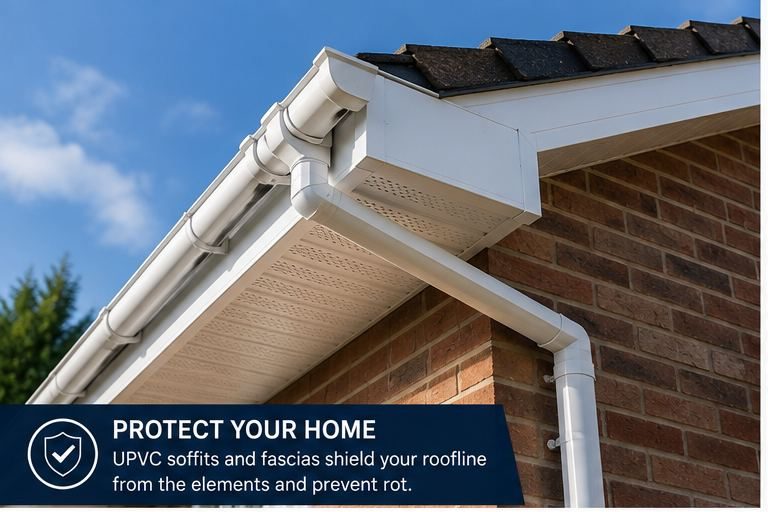
The fascia is the board fixed across the rafter ends at the eaves. It holds the gutter, closes the gap at the roof edge and shields the timber behind it from rain. When it is sound, water is carried away from the walls. When it cracks, splits or loosens, the roof edge becomes the weakest point of the house.
On inter-war and post-war homes the boards have often been in place a very long time, and the paint or finish has long since given up. That is usually when quiet damage begins, well before any stain or drip shows indoors, so the roof edge deserves an occasional look from the ground.
How damage spreads inwards
Rain that gets behind a failing board soaks the rafter ends and the top of the wall plate. Timber that stays wet softens, and the first course of tiles can lose its support and slip. Gutters fixed to a loose board also sag, so rainwater overshoots and runs down the wall instead of into the downpipe.
- Gutters sagging or overflowing at the roof edge
- Slipped tiles along the bottom edge
- Soft, dark or flaking timber at the eaves
- Damp patches on upper walls or ceilings
Birds, insects and ventilation
Gaps behind boards and in soffits let birds, wasps and other insects into the roof space. The same boards also matter for airflow, as the soffit usually carries the vents that let the roof breathe. A damaged or blocked soffit can leave the loft stale and damp, which feeds condensation on timbers and insulation.
Fitting vented soffits or vent strips when boards are replaced lets the roof space breathe properly again, which helps keep timbers and insulation dry and cuts down the stale, musty smell that some lofts develop when air cannot move through them at all.
What we check
From the ground we look at the line of the boards, joints, gaps, stains and any sagging gutter. Where access is arranged, we inspect the rafter ends and eaves, and judge whether timber behind the board is sound. Older houses get extra care: we check what existing soffit boards are made of before disturbing them.
Repair or replace
A small split or a single loose joint can sometimes be put right. Widespread rot or damage usually means fresh boards, new soffits with vents, and refitted gutters, which needs scaffold access. UPVC is very low maintenance and only needs cleaning, so once it is in, the eaves stop demanding attention. Ask what is being done to the rafter ends too.
Frequently Asked Questions
Can a damaged fascia cause a roof leak?
Yes, indirectly. Water can run behind the board and soak rafter ends, and a sagging gutter can push rain under the bottom row of tiles. The leak may then show indoors, some way from the damaged board.
Is a small crack in a fascia worth worrying about?
A hairline crack in a sound board may be minor, but it is worth watching. If the board is soft, bowed or stained, or the gutter is loose, the problem is likely to be spreading and is worth a proper look.
Do fascias and soffits need replacing together?
Often, yes. The two boards work together at the eaves, and when one has failed the other is usually close behind. Doing both at once means one scaffold and a neater result, and gives a chance to add proper vents.
Talk to our team about UPVC fascias and soffits in Shirehampton
Every roof is different — the fastest way to get an accurate answer is a quick chat with our team.