
Replacing the roofline is more than swapping boards. This is the sequence of work on a Bromley Heath house, from access to the final gutter connection.
Replacing fascias and soffits is a tidy, well-ordered job when done properly, but it has more stages than people expect. On the later 20th-century houses and older cottages of Bromley Heath, the exposed, windy edges mean the roofline works hard, so the preparation and fixing are worth doing well. We explain each stage before it starts.
Getting safe access first
Work at eaves height needs proper access. For most houses that means scaffold, or a tower on low roofs such as garages and porches. It lets the team work safely, handle long boards and reach the gutter line without leaning out. Access is arranged beforehand and the site is protected, so you know when it goes up and comes down. The scaffold also protects the garden and windows during the job.
A fair quote also describes how waste will be taken away and how the garden and drive will be protected while boards are lifted. Those practical details say a lot about how tidy the job will be, and a roofer who has thought about them in advance usually works carefully on the parts you cannot see.
Taking the old parts off
The gutters come off first, then the old fascia and soffit boards. This is a careful stage, because it exposes the rafter ends and the wall plate. Before disturbing older soffit boards we check what they are made of, and handle them accordingly. Debris is cleared as we go, not left in the garden for you to deal with. Older houses sometimes have surprises under the boards, so we stay careful.
Checking what is behind
With the boards off, we inspect the rafter ends and eaves timber. Rot, damp or insect damage is dealt with before anything new goes on, and any gaps where birds or insects have entered are closed. We tell you what we have found. Any loose or damaged felt at the eaves is also tidied and supported. Nothing is hidden behind new boards.
- Rafter ends sound, dry and firm
- Eaves felt in place and supported
- Gaps closed against birds and insects
- Roof space airflow kept clear
Fitting the new boards
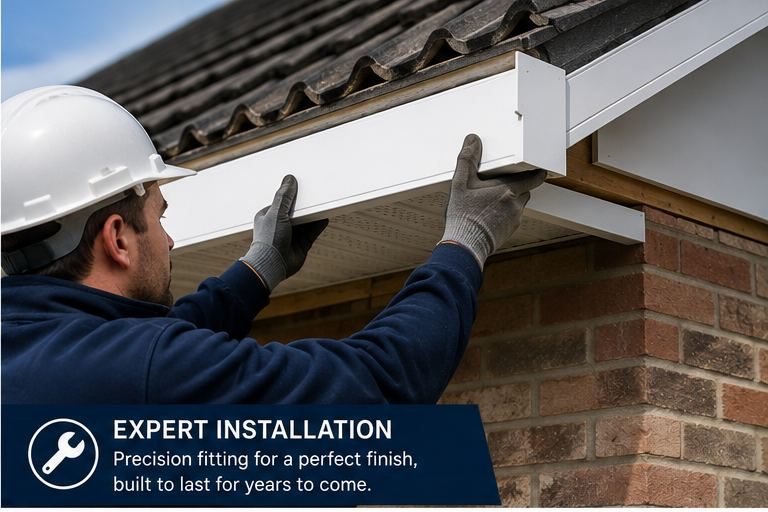
New fascias are fixed to the rafter ends, with bargeboards at gables where there are any. Soffits go in with vents or vent strips so the roof space breathes. Boards come in white and in darker and wood-effect finishes. The joints are neat, the line is straight, and UPVC is very low maintenance, needing a wipe over rather than paint. The result is a straight, even roofline.
Gutters and the finish
Gutters are refitted if sound, or replaced where worn, set to fall towards the downpipes and tied in properly at joints and stop ends. We check them with water before leaving. Then the scaffold comes down and the site is swept. You should have a straight roofline and water going where it should. Lasting work depends on this final check.
- Gutters aligned and falling to outlets
- Joints sealed and brackets firm
- Downpipes connected at the bottom
- Site cleared and swept clean
Frequently Asked Questions
Can fascias be replaced without scaffold?
On very low roofs a platform or tower may do. For two-storey houses, safe access at the eaves is needed, usually scaffold. We tell you in advance what will be used and for how long. Very low roofs sometimes allow other access.
Do I need new gutters with new fascias?
Not always. If the existing gutters are sound, they can be refitted. Old, cracked or sagging gutters are better replaced while access is in place. We assess them and let you choose. We look at the condition and the shape of the run.
Will replacement make the roof space damp?
No, the opposite when done properly. New soffits include vents so air moves through the loft, reducing condensation. We check that loft insulation does not block the airflow at the eaves. Insulation never blocks the vent.
Talk to our team about UPVC fascias and soffits in Bromley Heath
Every roof is different — the fastest way to get an accurate answer is a quick chat with our team.