
Painted timber fascias last a long time if kept dry and repainted, but there comes a point when replacing them is the better move. Here are the signs, and what we check on Horfield homes.
The fascia board carries your gutter, and it sits right where rainwater collects, so it is often the first piece of timber on a house to fail. Horfield has Victorian and Edwardian terraces, inter-war semis and extensions of every age, so you will find boards in very different states. Knowing the signs helps you decide when to repaint, repair or replace.
Signs the timber is past saving
Soft wood is the clearest sign. If a board feels spongy, flakes away or has deep cracks along the grain, water has got in. Peeling paint that keeps returning is another hint, because damp behind the paint pushes it off from below. Also look for gutters sagging between brackets, joints at corners opening up and dark staining beneath the board. These can show the fixing points are losing their grip.
- Soft or crumbling wood on the board
- Paint that repeatedly flakes and blisters
- Gutters sagging away from the wall
- Open joints at corners and board ends
- Dark staining or green growth below
When repainting is still enough
If the timber is firm all the way through and the paint is only tired, careful preparation and repainting may be sensible. A fascia in good shape does not need replacing for the sake of it, and we will say so. The catch is that repainting has to be repeated, and on boards at a height it needs access each time. Where you are already scaffolding for other work, replacement often makes more sense than painting again.
What UPVC changes
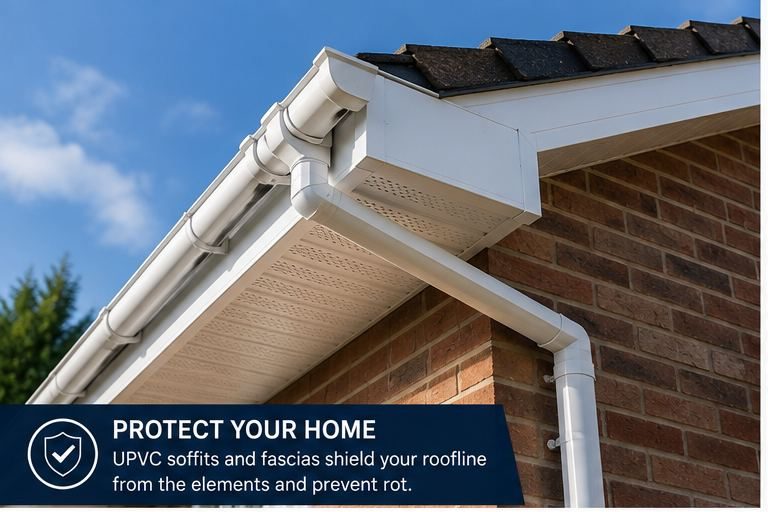
UPVC does not rot, and it is cleaned rather than painted, so it is very low maintenance compared with timber. It is available in white and in darker and wood-effect finishes, which suits the mix of older terraces and newer extensions across Horfield. It does not fix a problem hidden behind the board. If the rafter ends are damp or the gutter has been leaking for a long time, those must be dealt with first, or new boards simply hide the cause.
What we check before deciding
We look at the fascia, soffit, gutter and the rafter ends behind them. Rafter ends can rot quietly where water has run down the back of a board, and we want to know before anything new goes on. On older houses we also check what the existing soffit boards are made of before disturbing them. That is routine for us, and we tell you calmly what we find and how we will handle it.
Choosing the moment
The right moment is usually when boards are failing, when the gutters need renewing anyway, or when scaffolding is going up for other roof work. Doing it together saves repeat access and keeps the roofline matching. Replacement may need planning or Building Regulations checks — we advise before work starts.
Frequently Asked Questions
Can new UPVC go straight over rotten timber?
We do not recommend it. Covering soft timber hides it, and the rot carries on behind. We prefer to remove failed boards, check what lies behind and fix any damage first, then fit new boards on sound fixings.
Does UPVC ever need painting?
No. It is cleaned with warm soapy water from the ground when it gets grubby, which is why it is called very low maintenance. Check with us before using strong cleaners or pressure on any roofline.
Should gutters be replaced at the same time?
Often yes. Gutters have to come off to replace the fascia, and old brackets and joints are worth renewing while access is in place. We check their condition and tell you honestly whether they can go back.
Talk to our team about UPVC fascias and soffits in Horfield
Every roof is different — the fastest way to get an accurate answer is a quick chat with our team.