
Three parts of the roof edge are often lumped together, yet each has its own job. Knowing which is which makes it much easier to understand a problem or a quote.
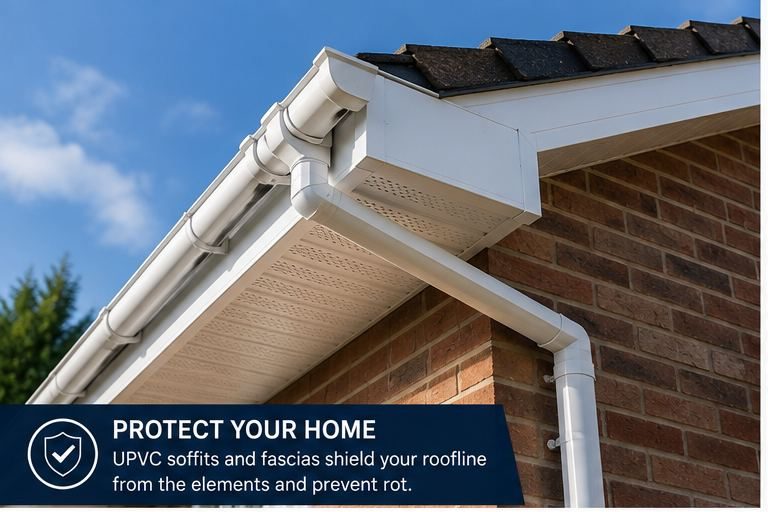
Stand outside any house on the newer estates of Emersons Green and look up at the eaves. You will see a board, a strip beneath it and a channel along the front. These are the fascia, the soffit and the gutter. They work as a set, but they fail in different ways, so it helps to know them apart.
The fascia
The fascia is the long board fixed to the ends of the rafters, running along the bottom edge of the roof. It carries the gutter, closes the gap between the wall and the roof covering and gives the roofline its finished look. If a fascia sags or comes away, the gutter usually sags with it and water spills down the wall. Some homes also have a bargeboard along the gable, which does a similar job.
The soffit
The soffit is the board that closes the underside of the eaves, between the back of the fascia and the house wall. On a modern home it often includes vents or a strip that lets air move into the roof space, which keeps the loft dry. A soffit that is cracked, missing or blocked can let in birds and insects or stop the roof breathing.
The guttering
The gutter is the channel fixed along the fascia that collects rain from the roof and carries it to the downpipes. It does not hold the roof together, but it protects the walls and the foundations. Leaks come from loose joints, sagging runs, blocked outlets and brackets that have pulled away from the board.
- Overflowing at joints or corners
- Sagging sections that hold standing water
- Damp marks or green staining on the wall below
- Loose brackets or gaps between gutter and fascia
How the three work together
Water runs off the tiles into the gutter, the gutter hangs from the fascia, and the soffit and its vents keep air moving beneath the roof. If one part fails the others suffer. A leaking gutter soaks the fascia, a cracked soffit lets damp into the eaves, and a poorly fixed fascia cannot hold a gutter straight. This is why we look at all three before suggesting work on any one of them.
What we look at
From the ground we check the line of the boards, the joints, any staining and where water is overflowing. If needed we examine the eaves closely, including the rafter ends, before advising on cleaning, repair or replacement. We will explain which of the three parts is actually at fault, and whether the problem needs a roofer or just a gutter clear-out. We always check from the ground first.
Frequently Asked Questions
Do all three need replacing together?
Not necessarily. If the fascia and soffit are in good order, gutters can be replaced alone. In practice, replacing boards means removing the gutters anyway, so many people renew all three at once. We tell you what is needed and what could wait.
What is a bargeboard?
A bargeboard is the board that runs up the edge of a gable end, where the fascia is on the long sides. It does the same job of finishing and protecting the roof edge, and it is usually replaced with the same material as the fascia.
Why do soffits have vents?
Vents let air move through the eaves into the roof space, which helps stop condensation and damp. Replacement soffits should include vents or a vent strip, so the roof continues to breathe after the work is done.
Talk to our team about UPVC fascias and soffits in Emersons Green
Every roof is different — the fastest way to get an accurate answer is a quick chat with our team.