
A roof that only leaks in a downpour is telling you something specific. On the newer estates of Emersons Green the cause is usually small, and it is rarely where the stain appears.
Heavy rain finds weaknesses that light showers never reach. Wind pushes water sideways, gutters overflow and every joint in the roof is tested at once. Houses on the modern estates around Emersons Green mostly have concrete tiles and dry-fixed details, so leaks tend to trace back to a handful of known points. Here is what is going on and how we find it.
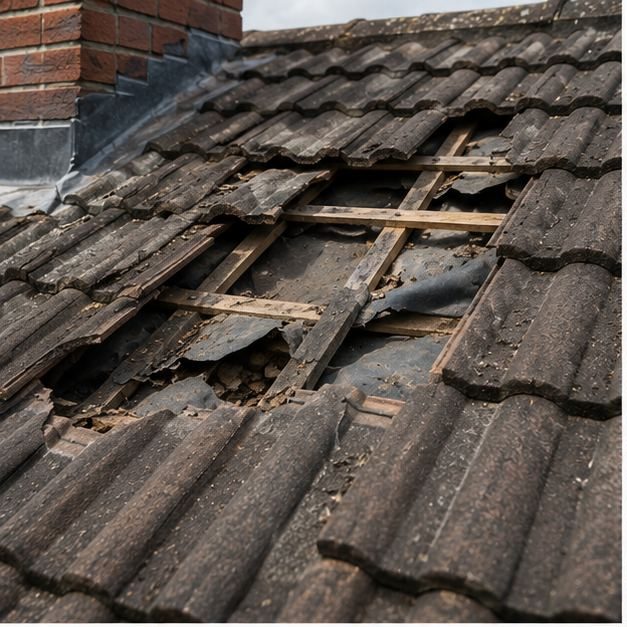
Water rarely drops where it gets in
Rain that gets past a tile runs down the underlay and along the battens and rafters before it drips. A stain on a bedroom ceiling can sit a long way from the actual opening. That is why guessing at the damp patch and patching above it so often fails, and why a proper trace starts at the roof, not at the stain.
Why it only shows in heavy rain
A small defect needs volume or wind to let water through. A slightly lifted tile, a tired flashing edge or a gap at a ridge end can stay dry through ordinary weather and then pass a good deal of water in a storm. Gutters add to it. If a downpipe or gutter cannot keep up, water backs under the lowest course of tiles and soaks the edge of the roof.
We often see the first sign only after several wet days, once the felt and timbers have taken on enough water to let it through. That delay is why a leak often seems to start days after the weather that caused it, and why a dry-looking roof can still be letting water in.
Likely points on a modern estate roof
Concrete-tiled roofs with dry-fixed ridges, verges and eaves fittings are neat and quick to build, but they have their own weak spots. Fixings work loose, clips fatigue, and the junction between roof and chimney, porch or extension depends on flashing that has to stay sealed. Short verges leave little margin when wind drives rain at the edge.
- Loose or displaced ridge and hip pieces and their fixings
- Flashings at chimneys, walls, porches and extensions
- Cracked or slipped tiles near the edge of the roof
- Verge and gutter-edge details that let wind-driven rain in
- Underlay that is torn or sitting wrongly behind the battens
What you can check without going outside the house
Go into the loft with a torch when it is dry. Look for daylight through the covering, dark or damp timbers, wet insulation and stained or dripping felt. Note where it is, then check the same spot after the next storm. Do not go onto the roof and do not use a ladder against it. Photos from the ground or the loft help us a great deal.
What we do about it
We look at the roof as a whole, trace the water back along the timbers to the real entry point and tell you what we find in plain terms. Often it is a repair to a few tiles, a ridge or a flashing. If the covering is failing more widely we say so and explain the options. Repairs are done with the right materials for the tile type.
Frequently Asked Questions
Is a leak in heavy rain an emergency?
It depends how much water is coming in and where it is going. Collect drips, move belongings and keep water away from lights and sockets. Call us for a proper look, because a leak that is small today can soak insulation and timbers if it is left through more weather.
Can a leak start on one side and show on the other?
Yes. Water follows the slope, then runs along battens, felt and rafters, sometimes across the loft, before it finds a way down. The visible mark is only where it finally breaks through, so the roof above and to the side of it needs checking.
Will the leak stop on its own when the rain does?
The dripping may stop, but the cause stays. Wet timber and insulation dry slowly and can rot or grow mould if the entry point is not fixed. A dry spell is a good time to get the roof looked at rather than waiting for the next storm.
Talk to our team about roof repairs in Emersons Green
Every roof is different — the fastest way to get an accurate answer is a quick chat with our team.