
Three parts at the roof edge get lumped together, yet each does a separate job. Here is what fascias, soffits and gutters are, how they connect, and why it matters on a Portishead house.
Walk round any house and look up at the eaves. You will see a board, a strip under it and a channel on the front. They are three different things working as a team, and a problem with one often shows up in another. Knowing which is which makes any quote far easier to read.
The fascia
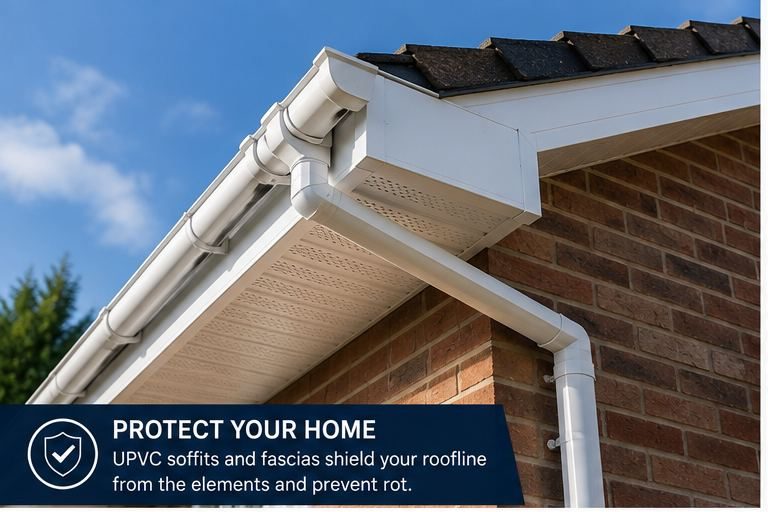
The fascia is the long board fixed across the ends of the rafters, facing outwards. Its job is to hold the gutter and to close the front of the roof edge against weather and birds. Where water sits against a timber fascia for long, it softens and rots, which is common on older homes.
On a gable end the equivalent board is the bargeboard, which follows the sloping roof edge. It is treated in much the same way as a fascia and is often replaced alongside it when the rest of the eaves is being done.
The soffit
The soffit is the board that closes the underside of the eaves, running from the fascia back to the wall. Vented soffits, or vent strips, let air move into the roof space so it can breathe and stay dry. Without that airflow, damp builds in the loft and timbers suffer.
The guttering
Gutters collect rain from the roof and carry it to the downpipes. They are clipped or bracketed to the fascia, so a sagging or rotten fascia pulls the gutter out of line and makes it overflow. Overflowing water then runs down the wall and wets the soffit and brickwork.
- Fascia: board across the rafter ends that carries the gutter
- Soffit: board under the eaves that closes the gap and helps ventilation
- Gutter: channel that carries rainwater away to the downpipe
- Bargeboard: the board on a gable edge, a close cousin of the fascia
Why this matters near the coast
Salt air, strong winds and driving rain are hard on all three. On the exposed seafront, joints in gutters work loose, and timber boards stay damp for long periods. Many newer estate houses already have UPVC boards, which are cleaned rather than painted and are very low maintenance.
What to ask when having them replaced
Ask whether the old fascia, soffit and gutters will all be removed, whether the rafter ends will be checked for rot and how the roof space will be ventilated afterwards. Scaffold or proper access will be needed. On older homes, we check what the existing soffit boards are made of before disturbing them.
Because the three work together, a leaking gutter joint can rot a fascia, and a rotten fascia can drop a gutter. Looking at the whole eaves line avoids fixing one part only to have the next one fail a season or two later.
Frequently Asked Questions
Do I have to replace the gutters when I replace the fascia?
Usually they come off and are refitted, because they are fixed to the fascia. If they are old, sagging or leaking at joints, renewing them at the same time saves paying for access twice, but that is your choice.
Is a soffit just cosmetic?
No. Besides tidying the underside of the eaves and keeping out birds and insects, a vented soffit lets air into the loft. Good ventilation helps keep roof timbers and insulation dry, which matters in a damp coastal climate.
What finishes can UPVC boards come in?
White is most common, but darker colours and wood-effect finishes are available too. UPVC is wiped clean rather than painted. We can talk through what suits your house and the look of the street.
Talk to our team about UPVC fascias and soffits in Portishead
Every roof is different — the fastest way to get an accurate answer is a quick chat with our team.